Get Full Government Meeting Transcripts, Videos, & Alerts Forever!
Get email alerts on the Policy Compliance topic
No spam. Unsubscribe anytime.
Board reviews state-driven updates to mandatory-reporting and student-records policies; clarifications and training planned
Summary
At the first reading the board reviewed revisions to policy JLF (reporting child abuse) required by Senate Bill 1437 and amendments to student-records policy JR and regulation JRR pursuant to House Bill 2514; changes expand the definition of mandatory reporters, clarify reporting routes and require notification/opt-in changes for directory data.
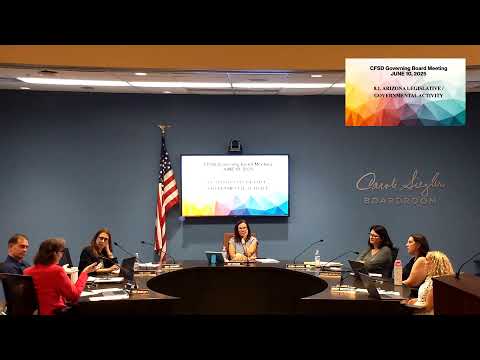
The Catalina Foothills Unified School District Governing Board discussed two sets of state-driven policy revisions at its June 10 meeting: updates to reporting suspected child abuse (policy JLF) tied to recent Senate legislation and changes to student-records policy (JR and regulation JRR) tied to recent House legislation.
Reporting child abuse (JLF): Associate Superintendent Mindy Westover told the board the draft updates implement Senate Bill 1437 and amendments to ARS 13-36-20 and ARS 15-5-14 relating to mandatory reporting. The revisions expand the definition of school personnel to explicitly include substitute teachers and governing-board members as mandatory reporters. The draft clarifies that a report made only to a school resource officer (SRO) or school safety officer does not fulfill the legal requirement to make a report under ARS 13-36-20; SROs who receive a report must immediately notify law enforcement and transfer all relevant information. The draft adds detail about SRO interviewing procedures and allows minimal follow-up questioning as permitted under county protocols (citing ARS 8-8-17). Staff reminded the board that annual training is provided and said legal counsel trains new teachers; principals provide recurring training. Board members asked to receive notice of training dates, asked whether substitute-provider agencies could certify training completion, and requested that staff tease out placement of some reporting requirements so they do not appear buried under a "failure to report" heading.
Student records (JR and regulation JRR): Cheryl Castro presented changes driven by House Bill 2514 that change the default for directory information. Under the revised language schools must notify parents/legal guardians or eligible students about the types of information designated as directory information, the right to refuse designation, and the time period for opting out. The policy clarifies that addresses, telephone numbers and email addresses may not be disclosed unless written consent is given or the parent/legal guardian/student has not opted out of the limited disclosure to official military recruiting representatives per ARS 15-142. Castro explained the draft changes that will move the district from an opt-out paradigm to an opt-in mechanism for sensitive contact fields and noted practical questions about how to obtain opt-in consent for families who already completed registration. Staff said they would produce a workable process for the coming school year and described the online registration workflow as the likely vehicle for opt-in.
Board members asked for clarification about where citations and the military exception appear in the text and suggested adding a short descriptive label to the legal reference. Several board members also requested consistent singular/plural usage ("parent" vs "parents") and replacing references to "governing board" with "district" where appropriate. Castro said staff would return refined drafts and that the regulations will list a transcript-release form for students to designate whether transcripts may be released to post-secondary institutions or armed services.
Why it matters: the policy changes implement recent state law and affect mandatory-reporting duties for a wider set of school personnel, clarify how reports are routed (school staff vs. SRO), and change how directory information is disclosed or withheld. The student-records change to an opt-in expectation for contact details could require an operational roll-out before the next school year.
No formal votes were taken; both policy packages were presented for first reading. Staff committed to schedule training and to return corrected, clarified drafts that elevate reporting obligations where appropriate.