Get Full Government Meeting Transcripts, Videos, & Alerts Forever!
Get email alerts on the County Budget topic
No spam. Unsubscribe anytime.
Spokane County tells department heads to meet board-set target budgets as officials work to close $20 million gap
Summary
County leaders told department heads and elected officials to meet target budgets for 2026, warning that without changes the county faces an estimated $20,000,000 structural gap; discussions covered use of new budget software, handling vacant positions and limits imposed by civil service rules.
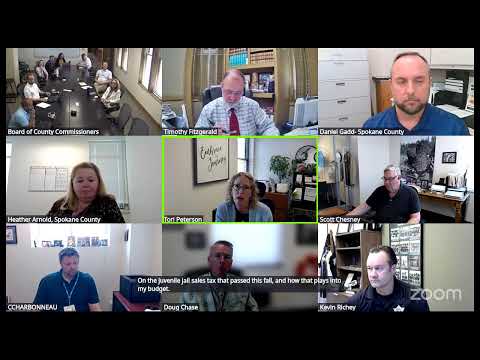
Spokane County commissioners and budget staff on Tuesday told department heads and elected officials that target budgets set by the Board must guide 2026 planning as the county works to close an estimated $20,000,000 projected budget gap.
“It's not a current year budget gap. It is if we did nothing for next year, we would have about a $20,000,000 budget gap,” said Scott, budget office staff, summarizing the county's financial projection and the rationale for earlier-than-usual budget work this year.
The target budgets issued to general fund departments are intended to hold overall spending at roughly 2025 levels while departments identify internal adjustments to absorb salary, maintenance and other cost pressures. Preliminary budget submissions are due in August and will be rolled up for the Board to review ahead of the preliminary 2026 budget in September, county staff said.
Why it matters: commissioners said meeting the targets will substantially reduce the projected gap and give the Board a manageable set of choices. Commissioner Cooney urged department staff to engage: “Please participate in this process. Do not sit this out,” she said, stressing that early involvement helps shape trade-offs and priorities.
County staff outlined several operational changes tied to the budget effort. Spokane County will begin using new budgeting tools—referred to in the meeting as Adaptive (Adaptive Planning) alongside Workday—to collect department submissions; training for staff who will enter budget data is scheduled next week. The county said only funded positions should be listed in budget submissions under the new system to improve clarity about funded full-time equivalents (FTEs).
That clarification raised practical concerns for some departments that rely on holding vacant but pre‑established position numbers to maintain candidate pipelines. “One of the issues we have with unfunded or vacant positions is through civil service. We have to have a position number to be able to prehire somebody,” said Kevin Rishi, a department representative. Ashley Torres, chief examiner with Civil Service, said the county is constrained by state requirements: “We are bound by RCW to allow them certain a certain number of applicants…based on the civil service rule of 5,” she said, explaining why the sheriff’s office has historically carried a set of unfunded position numbers to avoid long hiring delays.
County leaders said the move to Workday and Adaptive should create clearer workflows and make it easier to add positions later if funding returns, but they warned that the fiscal projection is a multiyear issue and positions eliminated through attrition may not be reestablished quickly unless revenues improve.
Commissioners also discussed funding to outside agencies. Staff noted the county has already reduced some partner payments and that some obligations are mandatory; the Spokane Clean Air Agency, for example, assesses jurisdictions by population and reduced its budget by 7 percent, which lowers Spokane County’s required contribution. The county asked departments preparing cuts to identify the highest-priority items to restore if future revenue becomes available and to describe service-level impacts in their budget narratives.
Next steps: the county will send training invitations and budget worksheets tied to the Adaptive Planning go-live. The Board indicated it will hold a leader/retreat session in July (targeted for July 21) to review department priorities before final submissions. County staff asked departments to flag priority positions and services to inform later Board decisions if revenues improve.
The discussion combined policy direction, procedural changes and practical constraints—especially civil service processes—without formal votes. Staff emphasized the budget timeline, the need for departmental prioritization, and the importance of early engagement to shape final Board decisions.