
Board directs staff to analyze options for a legislative work group, committee or existing process and report back
Get AI-powered insights, summaries, and transcripts
Subscribe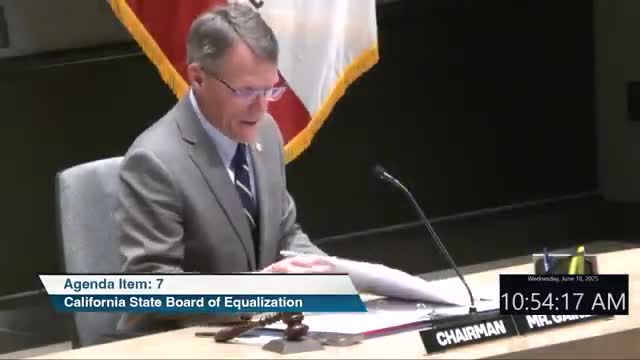
Summary
After a lengthy discussion on governance and AB 102 constraints, the Board asked staff to return in July with analysis of three options for handling legislative matters: a standing work group, a reformed legislative committee, or using existing board‑member agenda processes with updated governance rules.
The Board of Equalization on June 18 directed staff to return in July with analysis of options for how the board should handle legislation and formal requests to support or oppose bills. The board unanimously approved a motion to study three approaches and report back for a decision.
Member Tony Vasquez introduced a proposal to create a standing legislative work group that would function year‑round to vet bills and recommend board positions. “Each board member should be allowed to submit any legislative agenda items to the executive director for consideration by the work group chair,” Vasquez said in his memo introducing the item.
Vice Chair Sally Lieber and other members raised concerns about timing, transparency, and compliance with state open‑meeting rules, particularly AB 102 and the Bagley‑Keene Act. “I’d like to suggest that we pursue a work group rather than a committee,” Lieber said during floor discussion, adding that any structure must preserve members’ ability to act quickly on time‑sensitive legislation.
Chief Counsel Richard Moon and Executive Director Yvette Stowers advised the board on legal and procedural constraints. Moon recommended keeping the “work group” nomenclature to avoid recreating the committee structure that AB 102 constrained and warned that a standing body with broad authorities could create delays or raise Bagley‑Keene concerns if not carefully chartered. Stowers asked for clarity about whether staff resources would be used and offered to prepare options.
After discussion the board approved a motion directing staff to return at the July meeting with a comparison of three approaches: (1) a standing legislative work group as proposed by Member Vasquez (time‑limited through 2026 if desired), (2) a legislative committee model similar to the board’s pre‑AB 102 structure but adapted to current law, and (3) continuing to use the revised governance policy and the existing board‑member matters item with proposed improvements. Members asked staff to include suggested charter language, Bagley‑Keene/AB 102 analysis, and practical steps for timely action. The motion passed on a unanimous roll call vote.