
San Rafael police: human trafficking occurs in city; committee votes to recommend increased funding
Get AI-powered insights, summaries, and transcripts
Subscribe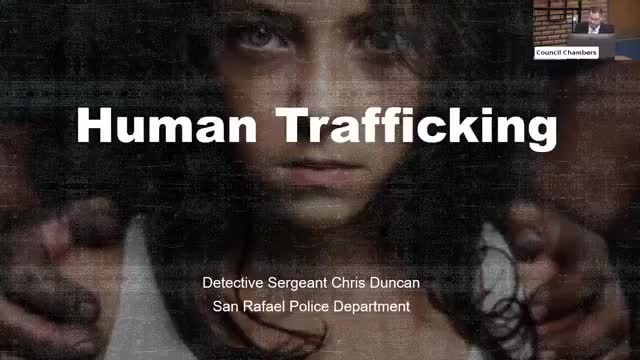
Summary
Sergeant Chris Duncan told the San Rafael Public Safety Advisory Committee that human trafficking occurs in San Rafael—concentrated in the Canal neighborhood and hotels—and that enforcement has been hampered by recent law changes. The committee voted unanimously to recommend increased funding to prevent and investigate trafficking.
During a presentation to the San Rafael Public Safety Advisory Committee, Sergeant Chris Duncan of the San Rafael Police Department said human trafficking occurs in the city, is concentrated in the Canal neighborhood and nearby hotels, and requires resource-intensive investigative work.
Duncan, who supervises the department's investigations unit, told committee members that human trafficking “is essentially modern day slavery” and that only a small portion of trafficking is visible to law enforcement — “no more than 6% of all human trafficking is captured in police records,” he said. He described common victim vulnerabilities as poverty, limited English proficiency and lack of immigration status, and said traffickers exploit those vulnerabilities with a mix of force, fraud and coercion.
The presentation laid out how traffickers operate locally: solicitation online, on the street in known “tracks” and inside businesses such as massage establishments. Duncan said victims contacted by police at hotels and on the street in San Rafael have been “typically black, brown, and white females,” and that certain labor- trafficking indicators have appeared in massage businesses.
Duncan described investigative and enforcement challenges, saying a 2022 change in state law — referenced in the presentation as the passage of “Senate Bill 357” and the repeal of Penal Code 653.22 — removed a tool officers previously used to separate suspected victims from traffickers. “As a result of that bill and related reforms, law enforcement can no longer detain or arrest individuals for loitering under [the repealed statute],” he said, adding that investigators now must rely more on resource-intensive undercover operations.
Committee members and members of the public pressed for more local data and for stronger partnerships. When asked for hard numbers, Duncan said that so far in 2025 the department had opened two cases related to human trafficking. He and committee members cited hotel managers, training for hotel staff, posting of help notices, school-based prevention and community reporting as tools to identify victims and disrupt trafficking.
Marlene Capra, founder of Speak Safe, Save Adolescents from Exploitation, urged prevention education in schools and parents’ vigilance online: “Our number one tool in preventing exploitation [and] human trafficking is prevention education,” she said, describing how social media, apps and gaming are now recruitment platforms.
Members discussed resource needs for proactive operations and detective time. Sergeant Duncan said his unit comprises six detectives and that larger operations require significant time and outside assistance. Committee members suggested larger investments in investigator staffing, community outreach and victim services.
On a formal motion near the meeting's end, the committee voted to recommend increased funding to prevent and investigate human trafficking. The motion carried on a roll call with all voting members recorded as voting yes.
The committee's packet materials include links to local victim-service organizations mentioned during the presentation, and members said a recommendation from the committee could be included in the body's upcoming report to City Council.