Get Full Government Meeting Transcripts, Videos, & Alerts Forever!
Get email alerts on the Public Finance Jail Bond topic
No spam. Unsubscribe anytime.
Cochise County officials review bond sizes, sales tax plan and ballot language for proposed jail project
Summary
Cochise County supervisors and finance advisors discussed options for issuing jail district revenue bonds, the possible half‑cent sales tax to pay them, amortization scenarios and ballot language; they moved to an executive session to finalize legal wording.
Cochise County supervisors and their finance advisers reviewed bond structures, revenue projections and draft ballot language Thursday as they continue planning a voter‑approved sales tax and revenue bonds to pay for a new county jail.
The discussion focused on how large a bond issue the county would need if final construction costs settle around $120 million to $130 million, how much a half‑cent transaction privilege (sales) tax would likely raise, and amortization options that would affect annual debt service and the county budget.
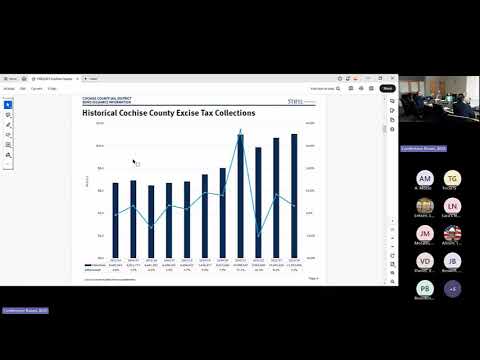
Mark Reeder, managing director at Stifel Public Finance, told the board the county could raise capital through Cochise County Jail District revenue bonds and recommended modeling multiple scenarios. “If the tax passes, we have a revenue stream by which to complete the construction of our jail,” Reeder said. He and his team used a working assumption that a half‑cent sales tax would generate about $10,000,000 annually and that the county’s maintenance‑of‑effort contribution would be roughly $6,300,000, producing roughly $16,300,000 of pledged revenue for investors.
Reeder said the county’s construction budget remained a “moving target,” noting planning estimates in the meeting ranged between $120 million and $130 million. He recommended the county consider a design‑to‑cost approach with the owner’s representative and the builder’s agent and said the team would meet the builder’s agent in July to refine estimates.
Advisors ran multiple amortization examples. Using a $100,000,000 bond assumption at an illustrative 4.5 percent interest rate, a 20‑year amortization produced estimated annual debt service Reeder described as “about $7.5 million,” leaving a cushion against the $10 million tax estimate. Shorter amortizations would reduce interest paid over time but increase near‑term annual payments and could require general‑fund supplementation until the sales‑tax revenue grows.
Reeder also discussed cash management and the use of bond proceeds. He noted that if the county issues bonds and invests proceeds during construction, modest interest earnings could be expected; he estimated “$3 or $4 million-ish” of interest earnings on a $100,000,000 drawdown during construction, which could be used to lower bond proceeds or cover overruns.
County staff and supervisors raised budget tradeoffs repeatedly. One supervisor emphasized that debt service would come out of available county resources that might otherwise go to roads or operations and asked about options to accelerate payoff using excess revenue or one‑time general‑fund contributions. Reeder said the financing could be structured to allow early principal paydown and described market conventions such as a typical 10‑year call lockout for municipal bonds; he said investors would accept accelerated‑call features but at a somewhat higher interest rate. “There’s a way to carve out that extraordinary call feature,” he said, adding that his team could seek no‑penalty call provisions and run trade‑off scenarios.
The board and advisers also discussed other fiscal levers. Reeder and supervisors mentioned the county’s unfunded pension liability and the potential to redirect some one‑time funds toward bond principal versus pension payments, noting tradeoffs and pursuit of a study session on that subject.
On legislative funding, Reeder confirmed the county was tracking a proposed $20,000,000 state set‑aside that appeared in the Arizona House budget but not in the Senate version; he said the county would watch reconciliation discussions and hoped the $20 million would be restored.
After the public presentation, the board voted to go into executive session to discuss ballot language under Arizona’s open‑meeting statute. A motion to enter executive session to discuss excise‑tax ballot language passed on a recorded vote of 3‑0. The board returned from executive session about 54 minutes later and scheduled a second executive session to consider legal counsel direction on a notice of claim before adjourning.
The advisers said the likely calendar would be a November 2025 ballot, with Department of Revenue collection of the tax (if approved) slated to begin in July 2026 and bond issuance to follow once planning, design and cost estimates were finalized. Supervisors asked staff and the advisers to return with refined scenarios and options for amortization, call provisions and reserve sizing.
This briefing did not include final decisions on bond size, ballot wording or amortization; the board moved those items into executive session for legal review and directed staff and advisers to continue preparing materials for future public meetings.