Get Full Government Meeting Transcripts, Videos, & Alerts Forever!
Get email alerts on the Municipal Finance topic
No spam. Unsubscribe anytime.
Norwood finance panel readies tax budget, centralizes vendor invoices and readies P‑card rollout
Summary
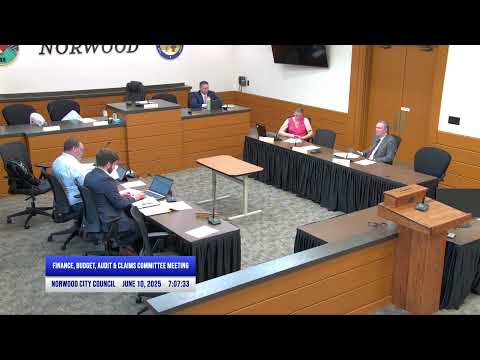
At a June 10 Norwood Finance Committee meeting, staff said they will submit a tax budget for first reading after verifying fund categorizations requested by the Auditor of State; the committee approved procedural steps to centralize vendor invoicing, prepare a purchasing card policy, and continue monthly review of accounting-method items.
Mr. Miracle, a finance staff member, told the Norwood Finance Committee on June 10 that the city will bring a tax budget to the full council for a first reading after resolving a minor Auditor of State question about three fund classifications.
The question, Mr. Miracle said, concerned whether funds 02/2084, 02/2085 and 04/4037 were categorized correctly; he said he would pull the original resolutions and expects to complete that check in a day or two so the budget can be placed on the agenda for the “20 fourth” and that a public hearing — “required by law,” he added — will be held the same evening.
The tax budget item was the meeting’s focal point because it drives revenue estimates used in the city’s Fiscal Recovery Plan and budget planning. Committee members and staff discussed recent increases in income-tax collections, a roughly $1.4 million surplus estimate if trends hold, and how tax-increment financing (TIF) bond terms and potential refinancing affect future capital funds.
On the record, Mr. Miracle said the Auditor of State’s reply asked staff “to verify that those are categorized correctly and to review the resolution when they were passed.” He identified fund 04/4037 as showing “$969,000 from Linden Point” on the certification spreadsheet and said he would notify committee members when the verification is finished.
The committee also directed several administrative changes staff will implement: a centralized vendor email (accountingnorwoodohio.gov) to receive all invoices; a monthly standing review of an internal “report on accounting methods” (a 34‑item checklist that spans multiple departments); and a schedule to present a key‑card manual and a purchasing‑card (P‑card) policy to council. Mr. Miracle said Mary Yeager, Sasha Gabbard and he will have access to the new vendor inbox and that staff will notify vendors to send invoices there going forward.
On the P‑card, Mr. Miracle said Republic Bank will introduce a new P card in early August and staff intend to present the P‑card policy through council readings timed to align with that rollout: a first reading on the “20 fourth,” a second reading in July and a final reading at the first meeting in August, so the new card can be used after the policy is adopted. He described the key‑card manual as 17–18 pages and said staff plan to put it to council for a first reading on the same “20 fourth.”
Committee members discussed TIFs and bond refinancing. One member noted the city has no general‑fund bond obligations; instead, outstanding notes are tied to TIF districts or specific projects. The committee referenced recent refinancing in a TIF district and discussed whether refinancing other revenue bonds might yield interest‑cost savings; Mr. Miracle said the city’s financial advisor (referred to in meeting as Andy Rosser/Broussard) monitors refinancing opportunities.
Members also examined a set of charts comparing local tax revenue sources and projections. A committee member who prepared visual charts noted property taxes are a smaller portion of Norwood’s revenue (about 13% on the chart) and said a five‑year “emergency” levy has been repeatedly renewed and will need replacement or renewal before it expires to preserve that revenue level.
A different discussion questioned a lane‑miles figure on a Census Bureau snapshot attached to the tax budget worksheet. The worksheet lists 142 lane miles and one councilmember said a previously cited verbal figure (about 128 or 114) differed; staff noted certified lane‑mile changes must be accompanied by a firm’s verified survey when submitted with the tax budget worksheet.
Throughout the meeting staff committed to follow up with committee members: to confirm the Auditor of State fund categorizations, to circulate the accounting‑methods report and end‑of‑month reports for review, and to prepare a more compact, layman‑friendly visual comparing past actuals and current estimates for future committee presentations.
The meeting closed with staff saying they will update members when the points raised are resolved and when the tax budget and associated documents are transmitted to council.