Get Full Government Meeting Transcripts, Videos, & Alerts Forever!
Get email alerts on the Public Health Cpr Training topic
No spam. Unsubscribe anytime.
Local physician urges residents to learn CPR, emphasizes AED use and the four-minute window
Summary
At the June 10 Middletown City Council meeting, a visiting physician gave an education presentation on cardiopulmonary resuscitation (CPR), detailing survival statistics, current guidance for bystanders and the role of automated external defibrillators (AEDs). Council members and staff discussed training access, AED locations and costs.
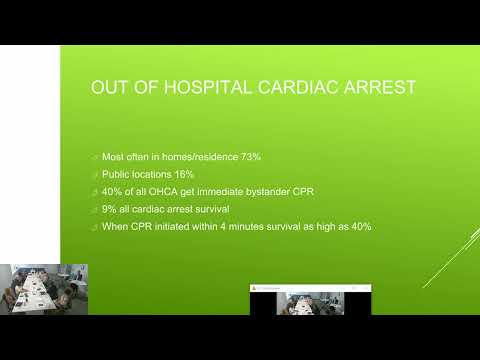
At the June 10 Middletown City Council meeting, a visiting physician gave an education presentation on cardiopulmonary resuscitation, telling the council that timely bystander action and use of automated external defibrillators can substantially improve survival from out‑of‑hospital cardiac arrest. "In The United States, approximately 400000 Americans die annually from cardiac arrest," the presenter said, and urged residents to "call 911" immediately and begin compressions if someone collapses.
The presenter summarized current guidance for lay responders: for bystanders with little or no formal training, the focus should be on chest compressions rather than rescue breaths. "Even if you're well trained ... the rate now is 30 compressions to 2 breaths. If you're a bystander and have minimal or no training, they actually tell you don't do any breaths. It's all just about compression," the presenter said.
Why it matters: the presenter repeatedly emphasized the narrow window for effective action, saying EMS average response time is about eight minutes and that "at 4 minutes, the rate of survival begins to drop dramatically." The presenter said properly started CPR within four minutes "has up to a 40 percent survival rate," and that early defibrillation further increases survival.
Details and local context: the presenter noted that automated external defibrillators are designed to reduce hesitation by lay users because the device evaluates a patient and delivers a shock only when indicated. "All those numbers we said earlier with CPR, if they get the AED shock within 4 minutes, it doubles the survival even those people who had the early CPR initiated." He told the council AEDs are still used in only a small share of out‑of‑hospital events, saying, "Only 9 percent of out of hospital cardiac arrest use an AE."
Council members and staff discussed where the city’s AED is located and local training options. One participant pointed out the City’s AED location in the lobby, and the presenter and others suggested local training options, including classes through the American Red Cross and Butler County Medical Reserve Corps. The presenter noted that classes can be short and that training in schools and workplaces increases public confidence: "I think it's key to get more people the confidence and training to to perform it."
Costs and practicalities: the presenter said consumer AED prices have come down, offering a general range discussed at the meeting of roughly "$800 to $2,000" for an at‑home or office unit, depending on model. Council members asked about insurance coverage; the presenter and attendees said they were not aware of routine insurance coverage for personal AED purchases.
Ending: Council members encouraged public awareness and training. The presenter provided sources for training and invited interested residents to seek classes; staff said they would coordinate posting training information and confirm the municipal AED location for public awareness.