
Lowell trustees establish Affordable Housing Trust Fund, accept $3.3 million ARPA seed
Get AI-powered insights, summaries, and transcripts
Subscribe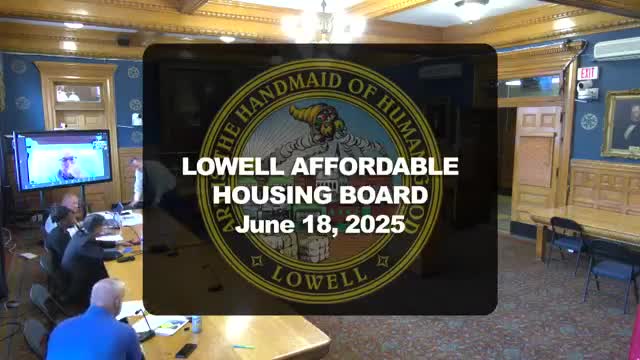
Summary
The newly formed Lowell Affordable Housing Trust Fund voted to accept $3,300,000 in ARPA funds and authorized the city manager to record a declaration of trust; trustees elected officers and set a July 16 follow-up meeting.
The Lowell Affordable Housing Trust Fund voted Wednesday to accept $3,300,000 in American Rescue Plan Act funds and authorized the city manager to record a declaration of trust, the board’s first formal actions.
The vote formally establishes the city’s Affordable Housing Trust Fund and allows the city manager or a designee to record the trust’s declaration with the registry of deeds. Assistant City Manager for Fiscal Affairs Connor Baldwin, who ran the inaugural meeting, told trustees: “This is our inaugural meeting.”
Why it matters: the $3.3 million is one-time ARPA seed money with two statutory deadlines the board must track. “There are 2 deadlines with the ARPA funds,” Baldwin said during the meeting, noting an encumbrance deadline that has passed and an expenditure deadline at the end of 2026.
At the meeting trustees also elected interim leadership, discussed a process for accepting and reviewing funding applications and identified possible longer-term funding sources. Eric Nelson, participating remotely, volunteered to serve as chair and Vallejo Paz volunteered to serve as vice chair. The board did not appoint a member secretary at the meeting; staff will continue to perform most administrative tasks unless a member is designated.
The board approved two formal items: accepting the ARPA funds into the trust and authorizing the city manager to record the declaration of trust. The motion to accept the funds was offered and seconded and passed on a voice vote; the authorization to record the declaration likewise passed on a voice vote. Individual roll-call vote totals were not read into the record.
Trustees and staff discussed next steps for standing up the trust. Baldwin said Department of Planning and Development staff have begun drafting application forms and processes and that the administration would present recommended procedures at a future meeting for the trustees to approve or modify. The board agreed to schedule a follow-up meeting and to invite staff from other communities and representatives from MassHousing to share best practices.
Board members discussed potential sustainable revenue sources beyond the ARPA seed, including automatic Community Preservation Committee (CPC) referrals (the Community Preservation Act sets aside 10% of CPC receipts for affordable housing in many communities), developer “linkage” fees set by city ordinance, transfers of city-owned tax-title or foreclosed properties to the trust, and fees such as a vacant storefront fee. Baldwin said the CPC could annually vote to designate a portion of CPC funds to the trust but that any new fee or ordinance would require City Council action.
Trustees set a tentative next meeting for Wednesday, July 16 at 4:30 p.m. and agreed to meet monthly during the initial ramp-up. Several trustees asked for morning meeting options to accommodate work and travel.
The meeting closed after trustees and staff agreed on immediate next steps: DPD to circulate draft application materials and the administration to invite outside presenters; trustees to review a MassHousing guidebook the administration will distribute.