Get Full Government Meeting Transcripts, Videos, & Alerts Forever!
Get email alerts on the Water Billing topic
No spam. Unsubscribe anytime.
Residents press Cannon Falls council on sharp water and sewer bill increases; staff cites meter-reading delay and rate structure
Summary
Residents told the Cannon Falls City Council in public comment that May utility bills jumped sharply; public works staff said a broken reader antenna delayed monthly reads and explained sewer billing and state-mandated tiered rates. Council agreed to review individual accounts and consider a work session.
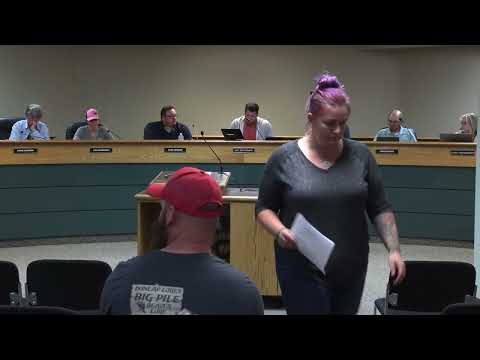
Several Cannon Falls residents urged the City Council on June 17 to investigate unusually high May utility bills that one speaker said rose 122 percent.
Resident Joe Gertin told the council he believed some households were billed for a longer period, saying, “it appears that we were billed for 5 weeks.” Resident Sadie Simmons said her May bill reflected “an increase of a 122%” compared with her nine‑month average and said she had been told the city had switched to a five‑week reading cycle without clear notice.
The concerns prompted a detailed staff explanation. Jed (identified in the meeting as public works staff focused on meters) said the city reads meters once a month and that an antenna on the city’s reading equipment had a bad wire and was returning far fewer reads, delaying billing about five days. “The antenna to our reader broke…we reached out to our vendor to get us a new antenna. They sent us a wrong antenna so…we prepared it and was able to read it,” Jed said, explaining the delay that increased the billed period.
Jed also described technical limits and remedies for customers who want more detailed usage data: staff can perform a data logger read for an individual meter that provides hour‑by‑hour usage going back “I think into March,” but that process is labor‑intensive and requires an operator visit. City staff said the billing system charges usage rounded to 100 cubic‑foot units, which can move a customer into a higher billing tier if the total crosses a threshold.
City staff and the council explained that the city’s tiered consumption rates are driven by state policy encouraging conservation. “The tiered system…is actually a state mandate that…cities that are built providing water have an increasing rate for their water consumption to help encourage people to conserve water,” a staff member said. Staff also described the sewer billing structure the city uses: the base sewer charge covers the first 300 cubic feet of consumption (the base charge cited in the meeting was $33.68) and consumption above certain thresholds is billed at an additional per‑100‑cubic‑foot rate (staff cited $11.76 per 100 cubic feet once over the higher tier).
Council members said the spike warranted further review. Councilmember Chris Jepson urged staff follow‑up and suggested a work session to brief the council and public on the billing policy and technical options. Mayor/administrator John (first name used in meeting) said staff would “take a deeper look or evaluate people’s bills to see if these claims are accurate” and asked residents to allow staff time to investigate specific accounts. The council noted that moving to an automated, continuous remote‑reading system would require substantial capital investment for new meters, network infrastructure and servers and could cost “hundreds of thousands of dollars,” according to staff.
The council did not adopt any policy changes at the meeting. Council members asked staff to evaluate individual disputed bills, confirm whether the delayed read impacted sewer tiers, and report back to the council as part of future budget and rate discussions.
City staff provided these contact options and remedies during the meeting: residents who question a bill may contact city hall to request a data logger read for their meter, and staff will review specific accounts for billing errors or timing issues. The council suggested a future work session or agenda item to explain the city’s billing cycle, sewer‑rate tiers and the operational tradeoffs of more detailed remote metering.