Get Full Government Meeting Transcripts, Videos, & Alerts Forever!
Get email alerts on the Budget Finance topic
No spam. Unsubscribe anytime.
Malibu City Council reviews FY 2025-26 budget; officials flag disaster costs, FEMA reimbursements and staffing needs
Summary
At a June 17 special meeting, the Malibu City Council received department-by-department presentations on the proposed fiscal year budget, heard that disaster response and rebuild costs have driven reserves down, and debated staffing additions, fee waivers for fire-impacted properties and strategies to pursue reimbursements and outside funding.
The Malibu City Council on June 17 reviewed the proposed fiscal year budget and detailed department presentations that highlighted the continuing cost of wildfire recovery, falling reserves and planned new positions to manage rebuild and resilience work.
City finance director Richard opened the council presentation, saying, “I'll be presenting the overview for you this afternoon, and I'll jump right into it.” The budget materials presented by staff show the general fund supplying the majority of city revenues, while staff emphasized that disaster response and rebuild costs have materially changed the city’s financial picture.
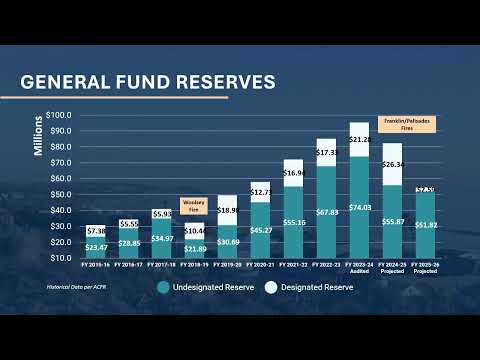
The council heard that disaster-related spending — including rebuild-center operations, cleanup, security and permitting support — and capital projects have reduced the city’s reserves. Staff said the city has spent about $12,000,000 on recovery services and roughly $23,000,000 in general-fund money on capital improvement projects over the past two years. The presentation noted the undesignated reserve declined from prior years to about $51,000,000 in 2025; several council members observed that without a one-time $6,500,000 transfer earlier the reserve would be about $45,000,000, close to policy minima used for bond-rating purposes.
City Clerk Kelsey reviewed the clerk’s office budget and told the council that public-records workload remains elevated: “We have 1,284 public records requests this fiscal year as of yesterday. Of that 490 have been fire rebuild requests.” Kelsey said the office added a full-time administrative assistant at midyear to help manage meeting support and records.
Public safety staff summarized a $16.8 million departmental budget and listed completed and planned safety projects, including the Kebu booster antenna, an initial phase of a PCH speed-safety program and installation of automatic license-plate reader cameras. Staff said they will continue wildfire assessments and update safety and training procedures after the after-action review.
Community services and public works presenters reviewed recreation, parks and infrastructure work. Community services asked for operating funds for new programs, shuttle service and maintenance tied to the permanent skate park, now under construction. Public works described a $9 million operating program, described 23 CIP and emergency projects totaling about $18.5 million next year, and noted ongoing FEMA public-assistance documentation for prior events.
The newly formed Community Development Department presented a $17,000,000 proposed budget and a staffing plan that would centralize planning, building and environmental functions. The presenter said the proposed department would add three mid-management positions including a deputy community development director and described priorities that include managing the fire-rebuild program, fee-waiver processes, ADU ordinance amendments, building-code adoption, and a safety-element update. “We are proposing a total budget of $17,000,000,” the presenter told the council.
Much of the council discussion focused on three financing challenges: (1) uncertainty about FEMA reimbursements and other outside funding, (2) one-time and ongoing costs tied to the rebuild center and fee waivers for fire-damaged parcels, and (3) whether to add high-level staff to lead recovery and modernization efforts. Council members urged aggressive lobbying and grant-seeking, including public–private partnerships and targeted advocacy in Sacramento and Washington, D.C., to secure state and federal funds. Staff said they are already engaging lobbyists, grant consultants and infrastructure funding partners.
Council members asked for more work on revenue strategies. Staff noted a recently identified funding source for safety improvements on Pacific Coast Highway: Metro Measure M transportation funds provided by the county supervisor’s office to support quick-build roundabouts and other safety measures. Staff also described options for speed-camera systems and said the capital cost (poles, signs) remains to be finalized and that camera hardware could be leased so ongoing operations would be vendor-managed.
Councilmembers also pressed staff on the budget treatment of fee waivers related to the Palisades rebuild. Staff said they had not included a specific fee-waiver appropriation in the baseline budget and estimated a ballpark figure of about $50,000 per rebuilt parcel as an illustrative planning figure; past experience from the Woolsey Fire involved roughly 246 parcels and approximately $6.2 million in fee-waiver value, staff said during the meeting.
Several council members urged immediate action on FEMA documentation and recommended hiring consultants if necessary to accelerate reimbursement. One council member said the city currently has an estimated $6.5 million of FEMA-related receivables included in the financial picture and urged that the city try to recover those funds quickly.
On staffing, staff recommended adding a deputy city manager to lead recovery, resilience and modernization work; presenters said additional senior capacity would allow the administration to pursue grants, partnerships and strategic financing. The council discussed parity for director salaries and asked staff to return with recommendations and supporting comparability data.
Procedural items at the meeting included approval of the agenda and the consent calendar. The council adopted both by voice vote. Staff said formal adoption of the budget is scheduled for a June 23 meeting; staff will return with any technical changes and follow-up information the council requested.
Council and staff listed follow-up items including more detailed projections of fee waivers by year, a plan and funding options for speed-camera capital costs, a schedule and scope for grant and lobbying activity, and further detail on proposed deputy-level positions in the budget. Several council members also encouraged staff to pursue naming-rights, donor and partnership opportunities to offset capital costs such as the skate park.
The council closed the special meeting after the discussion; staff will bring the revised budget and requested follow-up material to the June 23 agenda for adoption.