Get Full Government Meeting Transcripts, Videos, & Alerts Forever!
Get email alerts on the Zoning UDO Amendment topic
No spam. Unsubscribe anytime.
Town delays final vote on UDO change after commissioners request explicit attic standards for B‑1 zone
Summary
A June 19 public hearing considered removing UDO section 8.30.2 and adding a ‘habitable space’ definition; commissioners asked staff and counsel to preserve attic standards (dormer limits, knee-wall rules). The board kept the hearing open and continued final action to allow drafters to insert attic standards and circulate a revised ordinance.
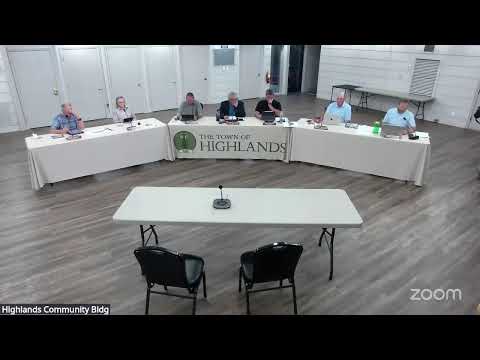
The Highlands Board of Commissioners opened a public hearing June 19 on proposed changes to the town’s Unified Development Ordinance (UDO) that would remove section 8.30.2 (floor-area rules for attics) and add a definition of “habitable space.”
Town Manager Josh Ward summarized the planning board’s recommendation to remove 8.30.2 on the basis that the UDO already regulates building height, habitable stories and built-upon area. Staff proposed a new definition of “habitable space” (area occupied for living, eating or sleeping, excluding closets, bathrooms, halls and utility spaces) aligned with the North Carolina building code, and suggested consolidating several related standards.
During discussion several commissioners and members of the public urged preserving the existing B‑1 (main-street commercial) attic standards that limit dormer length to 50 percent of the underlying wall line and prohibit exterior knee walls for habitable attic area. Commissioners said those standards help preserve the downtown architectural scale and prevent shallow-pitch roofs with tall knee walls that read as an extra story.
Town Attorney Nick Tosca advised that planning-board minutes and recommendations are not binding unless included in a recorded preliminary or final plat; he also said the UDO currently lacks a standalone attic definition. Tosca and staff recommended drafting a clear definition and relocating the attic conditions as explicit “attic standards” so they remain applicable to the B‑1 district.
After public comment and discussion, the board voted to keep the hearing open and continue final action to the next regular meeting so staff and counsel can draft revised language that preserves attic standards in a definition or separate standards section. No ordinance amendment was adopted on June 19.