Get Full Government Meeting Transcripts, Videos, & Alerts Forever!
Get email alerts on the Local Government Processes topic
No spam. Unsubscribe anytime.
Sammamish staff brief council candidates on meeting rules, public records and contracted services
Summary
City staff told prospective council members about the council-manager form of government, Washington’s Open Public Meetings and Public Records acts, and the city’s reliance on contracted services including police, fire and legal counsel.
City of Sammamish staff held a candidate orientation briefing for prospective council members in which they explained how the council-manager form of government works, the state laws that govern public meetings and records, and which services the city contracts out rather than provides directly.
The orientation, led by City Manager Scott McCall and Deputy City Manager Rachel Bianchi, covered the roles of council and staff, meeting types and rules of procedure. “Open Public Meetings Act … occurs when there’s a quorum of 4 or more members,” Bianchi said, summarizing a key constraint candidates must observe. She also emphasized the Public Records Act’s broad reach, noting records on personal devices that relate to city business are subject to disclosure.
Why it matters: candidates who win seats will need to navigate legal limits on private communications and the formal processes that create council direction. The session gave candidates the procedural background they would rely on when proposing policy or supervising the city manager.
City structure and meeting practice
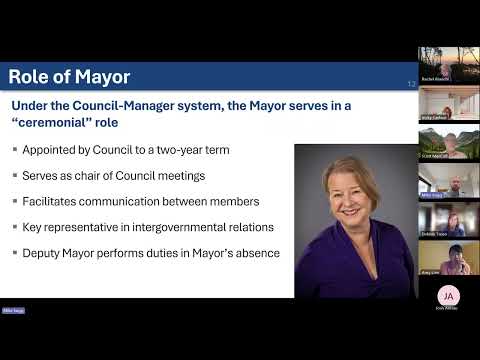
Scott McCall explained the city operates under a council-manager form of government: voters elect the council, the council appoints a ceremonial mayor from among its members and the council hires a city manager to run day-to-day operations. Staff prepare budgets, implement council direction and advise on policy. “Staff cannot take direction from 1 or 2 individual council members,” McCall said; staff work must be directed by a majority of the council during an open public meeting.
Bianchi described three meeting types: regular meetings (first and third Tuesday, where formal action is taken), study sessions (second Tuesday, generally for deep dives without formal action) and special meetings called when needed. She summarized executive and confidential sessions as “very rare” and limited to topics such as real estate acquisition, litigation, collective bargaining and personnel matters; participants in those sessions are required to keep the discussions confidential.
Contracts and service delivery
Staff detailed the city’s status as a “contract city,” where several core services are delivered through agreements with other agencies and private vendors. The briefing named Ogden Murphy Wallace (Carrie Sand assigned as city attorney) for city attorney services; the King County Sheriff’s Office for police services; an interlocal agreement with Eastside Fire and Rescue (EIFR) for fire services; Republic Services for solid waste; and multiple contractors for court-related and jail services. Staff also reminded candidates that many services residents ask about are provided by other entities — for example, the King County Library System operates the library next to City Hall and three school districts serve parts of the city (Issaquah, Lake Washington and Snoqualmie Valley).
Public engagement and resources
Staff said the city maintains a candidate resources page and a JotForm for candidate questions; responses submitted through those channels will be posted publicly as a transparency measure. McCall and Bianchi noted training is provided for new council members on rules of procedure and on Robert’s Rules of Order, and that recurring refresher training on OPMA and public records is required.
Questions from candidates during the session ranged from use of a recently purchased auxiliary maintenance site to procedural details about agenda packets and council representation on regional boards.
Ending
Staff said presentation slides and a recording of the orientation would be posted to the candidate resources page and encouraged candidates to submit follow-up questions through the city’s published form for a public Q&A record.