Get Full Government Meeting Transcripts, Videos, & Alerts Forever!
Get email alerts on the Public Integrity Complaints topic
No spam. Unsubscribe anytime.
Cotati Residents Urge FPPC to Improve Complaint Process After Years of Local Disputes
Summary
Residents from Cotati, Sonoma County, told the Fair Political Practices Commission they face coordinated local enforcement and election abuses, and asked the state agency to strengthen investigative help and its complaint form. Speakers described long-running local code-enforcement and 700-form concerns and requested investigator assistanc
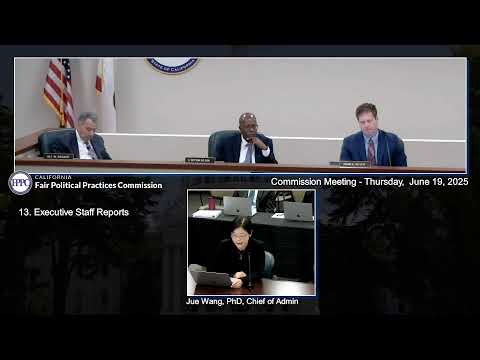
At the California Fair Political Practices Commission meeting on June 19, public commenters from Cotati, Sonoma County, urged the commission to improve its complaint process and provide more investigative assistance in complex, multi-party local disputes.
Laurie Alderman, a longtime Cotati resident, told commissioners she and others face a "complicated" situation involving multiple people, attorneys, city officials and city council members she says are using enforcement and code tools to "deprive people of fair elections, fair civil rights." She asked for more timely assistance from the FPPC, saying, "What we need is we need help now. Not 2 to 3 years when you get through the process."
Former Cotati council member George Barich asked the commission to reconsider a closed matter involving a code enforcement officer, Robert Smith, and said staff and commissioners should examine filings that he described as containing "blatant errors and omissions." Barich provided sworn declarations he said described alleged corruption and requested guidance on how the FPPC can assist. "We need an investigator in your office to help us through this process," he said.
A third commenter cited the Brown Act and the Bagley-Keene Open Meeting Act, reading statutory language about prohibitions on stifling public criticism and expressing concern that prior FPPC processes had discouraged meaningful public input. The commission's staff acknowledged the difficulty of hearing case-specific details where matters are pending, and commissioners emphasized the enforcement division had focused on serious violations in the recent consent calendar.
Staff and commissioners responded that the agency takes such complaints seriously and that, when possible, staff will work with jurisdictions and complainants to clarify filings and help them navigate the process. No formal action was initiated at the meeting; the comments were filed in the public record and enforcement staff indicated they would consider outreach and any suggested improvements to complaint filing tools.