Get Full Government Meeting Transcripts, Videos, & Alerts Forever!
Get email alerts on the Campaign Finance Payments topic
No spam. Unsubscribe anytime.
FPPC Prepares Rulemaking to Tighten Verification for Online Campaign Contributions; Flags Prepaid Cards
Summary
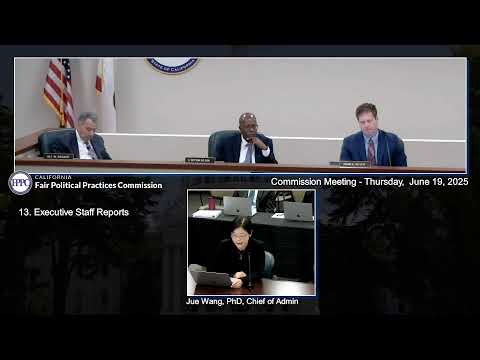
The Fair Political Practices Commission on June 19 discussed proposed rule changes to require stronger identity verification for online campaign contributions and to curb the use of prepaid cards that can be used like cash.
The Fair Political Practices Commission on June 19 discussed proposed regulation changes to tighten verification of online campaign contributions and to address use of prepaid cards for contributions and expenditures.
Senior commission counsel Zachary Norton told the commission enforcement investigators had uncovered instances where multiple contributions appeared to be charged to the same credit card but attributed to different contributors, and where prepaid cards were used to fund committee expenditures outside campaign bank accounts. "These are the issues that were brought to our attention by the enforcement division ... where there were contributions that appear to have been made multiple contributions made through the same credit card, but attributed to different contributors," Norton said.
Staff recommended requiring industry-standard verification steps — including address verification services (AVS) that compare contributor-supplied billing data to the cardholder’s issuer data and checks of the card verification code — and exploring blocking contributions originating from foreign IP addresses. Commissioners supported tightening verification but asked staff to study technical limits, including the prevalence of virtual private networks (VPNs) that can mask IP location, and to continue outreach to major processors such as ActBlue and WinRed.
On prepaid cards, staff described investigations in which committees issued or used reloadable prepaid cards and found expenditures that were difficult to trace because the cards function like cash. Norton said the proposed changes would treat certain prepaid cards as cash for recordkeeping and reporting and would allow vendors to flag and reject suspicious prepaid-card contributions. "These can be as simple as you go to the grocery store and you buy a $500 prepaid Visa card ... it's just not tied to anything," Norton said.
Commissioners suggested outreach to processors and recognized the balance between consumer privacy, legitimate uses of payment tools, and the need to prevent money-laundering and other illicit behavior. Chair Robert Silver proposed staff explore prohibiting processing from foreign IP addresses but staff noted VPN usage and legitimate cross-border situations could complicate a blunt prohibition.
Next steps: staff will develop proposed regulatory language, continue vendor outreach (including to ActBlue and WinRed), and return with a formal pre-notice and rule language for commission consideration.