Get Full Government Meeting Transcripts, Videos, & Alerts Forever!
Get email alerts on the Conflict Of Interest Nonprofits topic
No spam. Unsubscribe anytime.
FPPC to Draft Opinions on Whether Stanford University Counts as Source of Income for Palo Alto City Manager
Summary
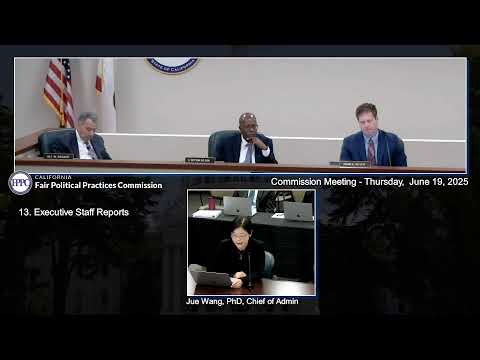
The California Fair Political Practices Commission on June 19 took up a request from the City of Palo Alto asking whether Palo Alto City Manager Ed Shikada has a source-of-income conflict under the Political Reform Act because his spouse works for Stanford Health Care.
The California Fair Political Practices Commission on June 19 took up a request from the City of Palo Alto asking whether Palo Alto City Manager Ed Shikada has a source-of-income conflict under the Political Reform Act because his spouse is employed by Stanford Health Care.
The question centers on whether Stanford University and Stanford Health Care should be treated as a single “source of income” for conflict-of-interest purposes. Senior commission counsel Kevin Cornwall summarized staff’s memorandum and told the commission the legal division does not see persuasive reasons to depart from prior advice letters that treated the two entities as affiliated in similar facts. "I'm here today to discuss the Palo Alto city attorney's request for a commission opinion regarding Palo Alto City Manager Ed Shikada's responsibilities under the Political Reform Act," Cornwall said.
The requester's counsel, Gary Winnick of Kaufman Legal Group, argued the organizations are separate under current bylaws and that the commission should issue a case-specific opinion finding no source-of-income interest, and also consider a rulemaking to give clearer guidance for nonprofit relationships. "Under the new bylaws, there's really three formal pieces of the relationship," Winnick said, citing (1) the university president's ability to appoint and remove hospital board members, (2) the university's power to approve amendments to the hospital's bylaws, and (3) a consultation requirement when selecting the hospital president.
Commissioners focused on board control as the most significant factor. Commissioner Brandt said board appointment and removal power is the critical indicator of direction and control, while Chair Silver and others asked staff to prepare opinion drafts that take multiple approaches. The commission directed staff to prepare opinion drafts reflecting different thresholds — one treating authority to appoint or remove a majority of hospital board members as dispositive, another focusing on whether the university can remove members without cause, and a third option that would offer alternative factor-based guidance — and to return with those drafts at a future meeting. No formal vote or final opinion was adopted at the June 19 meeting.
City Manager Ed Shikada, who attended, told the commission the matter had practical implications because city–university matters arise regularly, though he said decisions involving Stanford Health Care are less frequent. "The medical center, on the other hand, is geographically within the city of Palo Alto," Shikada said, adding that the city provides services to the university under contract and that the topics that frequently involve both entities include property and joint projects.
General Counsel David Bainbridge and staff also flagged the complexity of nonprofit structures and suggested any regulation would need careful stakeholder outreach. Commissioners asked staff to consider whether a regulation could provide a workable safe harbor or list of factors analogous to the for-profit rule in Regulation 18 700.2 (which speaks to voting control among business entities) but tailored to nonprofit relationships.
Next steps: staff will prepare opinion drafts limited to the specific facts presented and return at a later meeting, and staff will scope potential rulemaking and stakeholder outreach to determine whether a regulatory standard is feasible.
The commission did not take final action; the direction to staff was procedural (prepare opinion drafts and research rulemaking) rather than a binding order.