
California Acupuncture Board reviews wall‑license and consumer‑notice posting requirements
Get AI-powered insights, summaries, and transcripts
Sign Up Free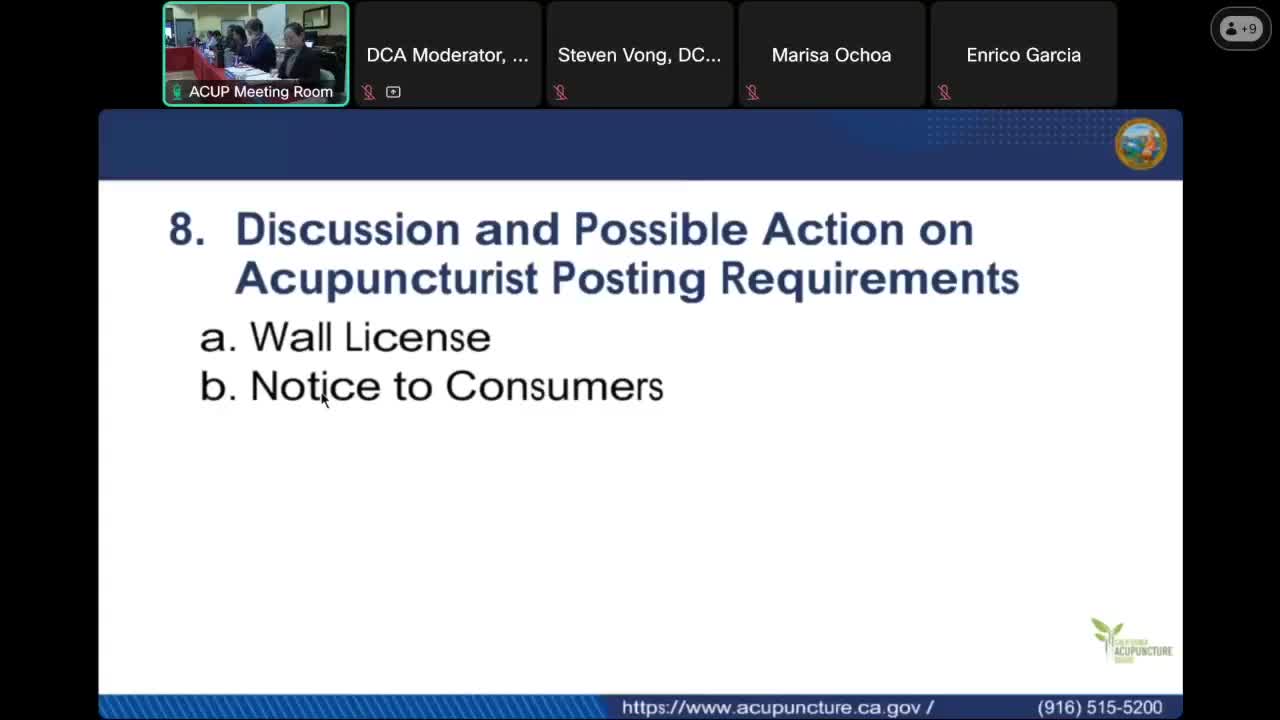
Summary
The board reviewed two posting requirements for licensed acupuncturists — a place‑of‑practice ("wall") license and a conspicuously posted "Notice to Consumers" — explaining how the requirements are enforced, what must be displayed and where licensees can get compliant materials.
The California Acupuncture Board discussed posting requirements that licensees must meet at each place they practice, including the board’s place‑of‑practice or “wall” license and a required “Notice to Consumers.” President Yongping Chen opened the item and Executive Officer Ben Badia summarized the rules and enforcement process.
The wall license is required for any physical location where an acupuncturist practices “regularly or semi‑regularly.” The board described the application as “relatively easy,” with a $50 fee for each location. The board’s consumer‑notice regulation (identified in the meeting as Cal. Code Regs. section 1399.469.3) requires that a printed notice stating “Acupuncturists are licensed and regulated by the California Acupuncture Board” be posted in a conspicuous public location at each practice; the notice must include the board phone number (916‑515‑5200) and the board website (www.acupuncture.ca.gov). The notice, when posted, must be a large readable size (the packet specifies 48‑point type in the example language).
Board staff told members they do not conduct routine inspections solely to verify postings. Enforcement typically occurs if a complaint prompts an investigation; posting violations may be added to the subject licensee’s cited violations and can result in citation and fines or orders to abate. Staff said they usually allow licensees an opportunity to come into compliance before escalating penalties. The board directed staff to make the consumer notice and a compliant PDF available by link in email renewal notifications and highlighted the Department of Consumer Affairs (DCA) “DCA Live Search” tool for verifying license status.
Public commenters and several licensees urged adding a photo to wall or wallet licenses so patients and first‑responders can readily verify identity; staff and board members noted budget and logistical constraints but said the board’s website already provides a printable, regulation‑compliant PDF of the consumer notice. No formal regulatory action or vote was taken on this item; the board placed the matter on the record for possible future action.