Get Full Government Meeting Transcripts, Videos, & Alerts Forever!
Get email alerts on the Accessory Structures On Vacant Lots topic
No spam. Unsubscribe anytime.
Board of Appeals upholds zoning committee on deck‑on‑vacant‑lot CUP; 5–0 decision
Summary
The Sawyer County Board of Appeals declined an appeal of a conditional‑use permit that allowed an accessory deck on vacant land, finding the zoning committee had adequate record and evidence; the appeal argued section 4.26 only covers permanent roofed structures and that the committee failed to make adequate findings.
The Sawyer County Board of Appeals voted 5–0 to deny an appeal against a conditional‑use permit that allowed a deck on vacant property in the Town of Ojibwe, ending the challengers’ effort to overturn the zoning committee’s February approval.
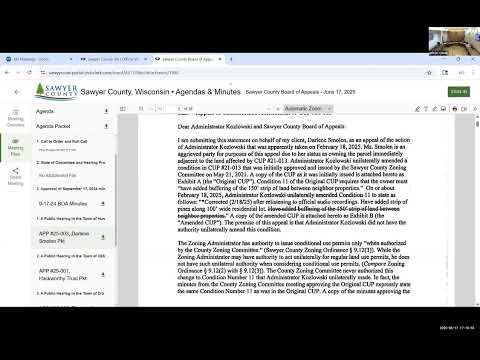
Attorney Nick Sedaris, representing appellants Michael and James Hackworthy, argued the deck does not qualify under Sawyer County Code Appendix D §4.26 — which addresses accessory structures on vacant property — because the ordinance targets “permanent roofed structures” and the deck is not roofed. Sedaris also argued the zoning committee’s written findings did not demonstrate the board considered whether the property was buildable or whether the principal dwelling would be constructed within three years as the ordinance requires.
Zoning counsel Malia Malone and others told the appeals board the county code defines accessory structures to include decks and that Section 4.26’s initial sentence about roofed structures does not render other text meaningless. Malone also cited Wisconsin statute 895.463, which instructs courts to resolve zoning ambiguities in favor of the free use of private property. Zoning staff said the record included evidence the lot was buildable, that a past variance applied to the parcel and that the applicants had represented they will build a principal dwelling within three years.
After closing public comment, the appeals board discussed whether the committee had jurisdiction, whether it applied the correct legal standard and whether substantial evidence supported the committee’s approval. The board concluded the zoning committee had acted within jurisdiction, had not proceeded on an incorrect theory of law and had substantial evidence supporting its decision. The motion to deny the appeal passed 5–0.
The decision leaves the conditional‑use permit in place; the appellants’ legal options include a circuit‑court appeal. Board members urged clearer, more specific written findings in future zoning committee decisions to reduce similar appeals.