Get Full Government Meeting Transcripts, Videos, & Alerts Forever!
Get email alerts on the City Budget topic
No spam. Unsubscribe anytime.
Bonita Springs unveils preliminary 2025–26 balanced budget; millage, stormwater votes set
Summary
City staff presented a preliminary, balanced fiscal 2025–26 budget that keeps the current millage rate, details capital spending and reserves, and schedules the millage and stormwater votes for July and September under state timing requirements.
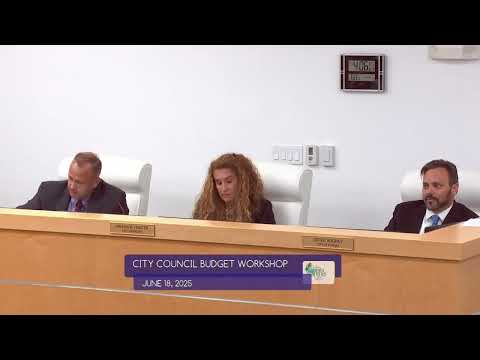
Lisa (budget staff) presented the City of Bonita Springs’ first preliminary draft of the balanced fiscal year 2025–26 budget and the calendar for adoption, saying, “We’re here to present the first preliminary draft of your 25/26 budget.”
The draft keeps the current millage rate at 0.847 and retains the present stormwater utility fee while laying out a capital improvement program that includes large multi‑year projects. The city will hold a preliminary millage vote and stormwater utility vote on July 16; tentative and final budget hearings are set for Sept. 3 and Sept. 17, each at 5:30 p.m., chosen to meet requirements in Florida statutes.
The budget presentation emphasized revenue diversification: ad valorem taxes account for about 33 percent of citywide revenue, with capital projects driving most expenditure spikes. Lisa said the draft relies on historic trends and quarterly state revenue estimates and that staff will update projections after the state issues its next estimates in July.
On reserves and disaster recovery, the draft lists operating reserves of $5,400,000 and disaster reserves of $2,800,000, for combined operating and disaster reserves of $6,500,000 in the general fund. Staff noted the city is still awaiting roughly $1,700,000 in FEMA reimbursements related to recent storms; the presentation flagged those outstanding reimbursements as affecting the reserves picture.
The budget includes the local government emergency bridge loan, a $2,000,000 loan the state allows cities to retain with no interest or payments due until its 2033 maturity; Lisa said the loan “can be utilized for operating after a disaster” but only for operating costs tied to a natural‑disaster response.
Staff budget assumptions also include a 3.01 percent continuation increase for operating costs and a 15 percent assumed increase for employee health insurance. The presentation listed a continuation‑budget funding request of roughly $614,400 for new or extended services; staff said individual line items would be brought back for council discussion.
Council members sought context on planning for population and commercial growth and whether the capital program and staffing plans reflect projected increases. Lisa said CIP review will begin in November and that internal planning for next fiscal year begins in October; she also noted the city is projecting impact fees over a five‑year horizon to inform CIP funding.
Staff closed by inviting further questions and one‑on‑one briefings to walk through specific CIP projects before the council’s July preliminary millage vote.