Get Full Government Meeting Transcripts, Videos, & Alerts Forever!
Get email alerts on the Economic Development topic
No spam. Unsubscribe anytime.
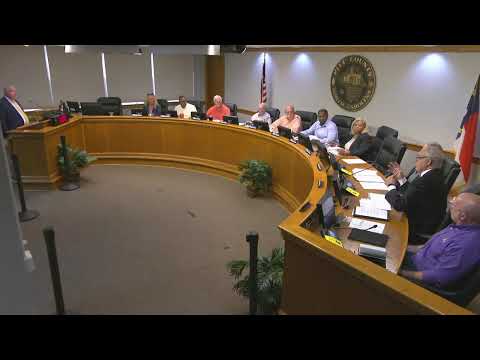
Planning board recommends approval of Weyerhaeuser mega-site land-use change and rezoning after lengthy public comment
Summary
The Pitt County Planning Board voted to recommend approval of a land-use map amendment and rezoning request from the Weyerhaeuser Company that would redesignate and rezone about 3,319.59 acres as employment/industrial and establish a conservation-area overlay for parts of the property.
The Pitt County Planning Board voted to recommend approval of a land-use map amendment and rezoning request from the Weyerhaeuser Company that would redesignate and rezone about 3,319.59 acres as an employment/industrial site and to establish a conservation-area overlay along portions of the property.
Planning staff presented the request as concurrent land-use and zoning actions intended to make the property viable as a potential 1,000-acre “mega site” suitable for large-scale industrial development. The staff presentation said the Economic Development Partnership of North Carolina (EDPNC) had identified the Weyerhaeuser site as one of seven potential mega sites in the state. Planning staff said approval of the land-use change and rezoning was required to access roughly $10 million in state grant funding for due diligence and approximately $97.8 million for site development (figures provided by staff during the presentation).
Jonas and planner Jonathan Hill described the property as largely timbered and in active forestry production; the county’s land-use map currently designates most of the parcel agricultural or rural residential. The Weyerhaeuser request would change the map to an employment/industrial designation and rezone the site from rural agricultural/rural residential to general industrial. Weyerhaeuser and representatives from the Greenville Eastern North Carolina Alliance told the board the county would negotiate an option to buy a minimum 1,000 contiguous acres for a pad-ready mega site and that the county/alliance would pursue state due-diligence and infrastructure grants if the planning and engineering work supported development.
Representatives at the hearing included Josh Lewis of the Greenville Eastern North Carolina Alliance and Tim Jackson, senior director of real estate development for Weyerhaeuser. Scott Anderson (ARC Consulting Group) said the proposed rezoning lines were set to leave at least 500 feet between proposed industrial zoning and any existing homes and included 100-foot conservation-area overlays where the property abuts private residences. Jackson said Weyerhaeuser would continue timbering and recreational leases on lands not sold for industrial development and would not clear trees for industrial development unless the county and alliance purchased the property and proceeded with development.
The board heard extended public comment (dozens of residents spoke) raising recurring concerns: localized flooding and drainage problems, standing water on properties after recent rains, wildlife and wetland impacts, road capacity and safety on Bridal Road, Saintsville Road and Brawley Road, and uncertainty about who would build and live near a future industrial site. Multiple speakers said they fear loss of trees, increased runoff, and greater traffic; several asked whether any local guarantees exist that tax revenue from a future industrial user would be dedicated to addressing local infrastructure such as drainage or emergency services.
Planning staff and economic-development speakers described the grant-driven process as phased: an initial due-diligence study (environmental, wetlands delineation, wildlife, traffic analysis) followed by potential state infrastructure funding and then site development. Josh Lewis said the state program requires a property be zoned for industrial before EDPNC will commit due-diligence funds so the community and state “know you want industrial in this area” before spending significant state money on feasibility work.
After a motion to deny the land-use amendment and rezoning failed, the planning board voted to recommend approval. Planning staff said the recommendation will be forwarded to the Pitt County Board of Commissioners for a public hearing on July 21, where the commissioners will make the final decision. Staff recommended approval based on the site’s size, single ownership, proximity to a four-lane road and utilities, and designation as a potential mega site by EDPNC; staff told the board the Greenville Utilities Commission agreed to provide sewer service for the site without requiring voluntary annexation.
If commissioners approve, planning staff said subsequent development would require detailed site-plan review, environmental permitting, stormwater control measures, traffic mitigation as required by N.C. Department of Transportation, and additional county-level approvals for subdivision or infrastructure that do not automatically come back to the planning board for final action.