Get Full Government Meeting Transcripts, Videos, & Alerts Forever!
Get email alerts on the Telecommunications topic
No spam. Unsubscribe anytime.
Neighbors and planning commission push back on 245-foot cell tower proposal; consultant asks council to approve or allow tabling
Summary
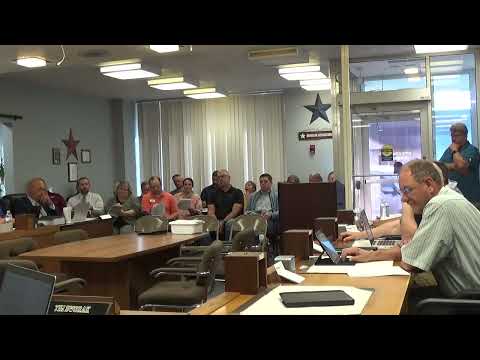
The Seward City Council on Tuesday considered a special-use permit request to build a 245-foot telecommunications tower in the city’s extraterritorial jurisdiction, a proposal that drew opposition from the planning commission and nearby homeowners.
The Seward City Council on Tuesday considered a special-use permit request to build a 245-foot telecommunications tower in the city’s extraterritorial jurisdiction, a proposal that drew opposition from the planning commission and nearby homeowners.
Planning staff reported the planning commission’s recommendation failed: “the recommendation to approve the conditional use permit failed; it was 0-4 and 6 against to approve this initial use permit,” the record shows. Opponents and commission members expressed concerns about fall-zone setbacks, whether existing towers or the water tower could be used instead (colocation), landscaping and visual impact, and radio-frequency health worries, though staff noted the Federal Communications Commission regulates RF safety.
Woody Crowe, a consultant representing the applicants and site-acquisition team, urged the council to approve the permit and said the applicants had revised their plans to meet landscaping requirements and submitted an engineering letter addressing fall-zone concerns. “We meet all requirements of the code other than that setback issue for which we provided the cogent fall zone letter. Therefore, we respectfully ask for your approval this evening,” Crowe said. He also requested that if council intends to deny the application, the applicant be allowed a month or two to produce additional technical documentation and carrier confirmations.
Why it matters: the tower would be 245 feet tall and proposed for a site east of Seward in agricultural zoning within the extraterritorial jurisdiction. The applicant provided an engineering letter attesting to a 75-foot “crumple” fall zone and sought a reduced setback to permit the tower to be sited close to a property line; the planning commission expressed concern that a structural failure greater than the engineered crumple distance could still allow debris to fall onto neighboring parcels.
Public comments included a written statement from the Ridge Run homeowners association read by Joel Jermer. The association said simulated photos provided to residents appeared misleading and noted an existing tower roughly two miles to the north. The HOA representative’s prepared remarks said, in part, “The simulated photos that we have received seem very misleading, considering that there is an existing tower just a couple of miles to our north.”
What’s unresolved: planning staff noted questions about whether co-location opportunities were fully exhausted and whether Verizon or other carriers might share capacity on an existing tall structure; the applicant’s consultant said he had contacted multiple landowners and found only the current site was a willing location that fit the network coverage and capacity needs. The council did not record a final determination on the special-use permit during the hearing portion recorded in the transcript.
Next steps: the council may vote on the special-use permit at a subsequent council meeting or may table the item at the applicant’s request to provide additional technical evidence about structural fall-zone design and carrier colocation opportunities. Planning commission materials and the applicant’s coverage maps should be requested for any follow-up review.