Get Full Government Meeting Transcripts, Videos, & Alerts Forever!
Get email alerts on the Budget Staffing topic
No spam. Unsubscribe anytime.
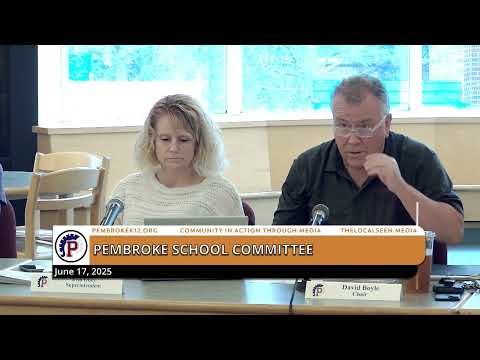
Pembroke schools lay off five staff, freeze hires as teacher bargaining proposals exceed budget
Summary
Pembroke Public Schools laid off five staff and froze several vacant positions after union contract proposals exceeded the district's budget; administrators warn class sizes may rise and some course offerings could be reduced.
Pembroke Public Schools officials said the district laid off five employees on the last day of the school year and placed several vacant positions on a temporary hiring freeze after collective-bargaining proposals from employee groups exceeded the funds available in the town-approved budget.
Superintendent (name not specified) told the School Committee that 50 bargaining proposals have been received so far and "of those 50, more than 40 of them have a fiscal impact," and that those proposals significantly exceed the assumptions used to build the fiscal 2026 budget. The superintendent said the district exercised a hiring freeze and issued layoff notices to create capacity to continue negotiations over the summer.
The district said the five layoffs included four paraprofessionals and the high school librarian. Officials said the four paraprofessionals would remain district employees in other paraprofessional roles where possible, and that principals are working with volunteers and program adjustments to keep core services running.
Why it matters: Officials said the staffing decisions are temporary measures to allow bargaining to proceed without exceeding the budget approved by the town. The committee emphasized it remains committed to maintaining program quality but warned that program adjustments and larger class sizes could be required if the contracts proposed by employee units are adopted.
Administrators described specific program impacts they expect if the freeze holds. At the high school, district leaders said they will not fill an open science teacher, an open English teacher, a 0.4 business position and a fractional world-language position; the district identified 3.4 full-time-equivalent positions in total that would not be replaced immediately. District leaders said that in practical terms this would require collapsing sections and could push average class sizes from the low 20s into the mid-20s, with occasional outliers near the upper 20s.
Officials noted elective offerings may be reduced: the district said Latin, which has comparatively low enrollment, is the most at-risk course if world-language staffing must be reallocated. At the high school, administrators said some elective sections, such as business communication, could be cut from five sections to four. The superintendent described the tradeoffs this way: "You can't lose 20 teaching sections and expect to have the same level of offering and compatibility with student requests."
District leaders also outlined other positions they plan to hold pending bargaining outcomes, including an elementary math interventionist and components of a proposed district behavioral program (a BCBA, an RBT and a counseling coordinator). They said principals were advised to slow hiring on a few currently open positions while the bargaining picture clarifies.
The committee said contracts expire June 30 and that state rules require certain notices to employees by mid-June; the superintendent noted the timing made this period particularly difficult. The superintendent said negotiators will meet again the next day and that School Committee members expect extensive work over the summer to finalize agreements.
Public comment and local concerns: During public comment, a parent urged the committee to preserve library and STREAM programming, which she said has been reduced already; the district noted volunteers and technology staff are working to push STREAM-related instruction into classrooms where feasible. Parents and principals also raised concerns about the cumulative effect on students who are preparing to enter regional vocational programs that require sustained exposure to technology and library resources.
Next steps: The School Committee said it will continue negotiations with the employee units over the summer and will update the committee and public at future meetings; officials said any final successor contracts will have to fit within the town-approved FY26 budget.