Get Full Government Meeting Transcripts, Videos, & Alerts Forever!
Get email alerts on the Economic Support topic
No spam. Unsubscribe anytime.
Walworth County reviews economic support program: staffing, training and potential state funding shifts
Summary
Walworth County staff presented an annual overview of the Economic Support Services program, describing a five-county Moraine Lakes Consortium, staffing and training timelines, improved FoodShare error rates, and concerns about proposed state cost-sharing changes that could shift administrative costs to counties.
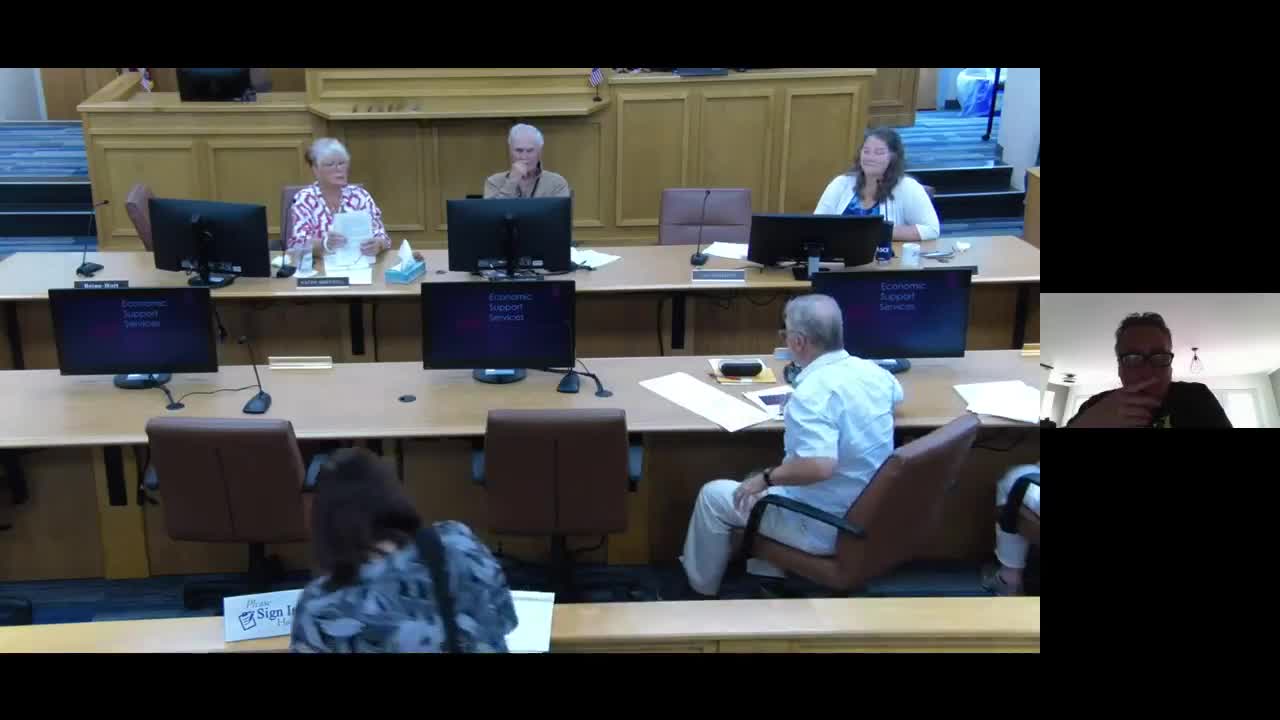
Walworth County Health and Human Services staff presented an annual overview June 18 of Economic Support Services, which operates in a five-county Moraine Lakes Consortium and administers benefits including health care, FoodShare, child-care assistance and Medicare premium assistance.
The program matters because it handles federally funded benefits on behalf of county residents and relies on a trained workforce; department presenters said the team includes 27 full-time FTEs and one part-time LTE, six bilingual Spanish-speaking staff, and subject-matter specialists for child care, fraud/overpayment, and long-term care. The county also operates a regional call center shared with Fond du Lac, Ozaukee, Washington and Waukesha counties.
Mia Anderson Inman, lead economic support services supervisor, and Barb Propera, economic support services supervisor, told the board the unit has seen increasing turnover: four staff left in 2023'24 and five had left by June 2025. They described an extensive training pipeline for new economic support workers that the presenters said typically takes about 30 weeks from posting to independent casework: eight weeks of state virtual training, eight weeks of one-on-one lead training with live-case review, two weeks of monitored call-center work, then progressive independence over a five- to nine-month period.
The presenters said Moraine Lakes has met timeliness benchmarks for applications and renewals and that average speed-of-answer targets are 10 minutes. Call volume has fallen after the COVID unwinding and the introduction of online application and renewal tools.
The presentation addressed FoodShare quality-control reviews required by federal rules; county staff said the Moraine Lakes Consortium's error rate has improved and that fiscal year 2024 results may place the state among the best nationally, pending final federal reporting. Common local error types include unreported income and misreported shelter costs; staff said system checks that hold confirmations for review have helped reduce errors.
Presenters warned of possible state-level policy changes that could shift costs to counties. They summarized a pending state bill's elements under discussion, including expanded work requirements for Medicaid and FoodShare, reduced retroactive Medicaid coverage, and a proposed state cost-sharing model for benefits administration that could pass more administrative costs to counties. The presenters said even with the consortium's low error rate, a statewide cost-share model could create significant county-level funding uncertainty.
No committee action was taken; the presentation was informational and staff said they will continue to monitor state budget developments and report significant changes to the committee.