Get Full Government Meeting Transcripts, Videos, & Alerts Forever!
Get email alerts on the Water Wastewater topic
No spam. Unsubscribe anytime.
Dover to pass modest water and wastewater rate increases tied to third-party rate study; ARPA funded projects cited
Summary
City staff said residential water and wastewater bills will rise modestly next year based on a recent third‑party rate study and that drinking-water projects used about $4.2 million of the city's ARPA allocation for a State Street main replacement and a new production well.
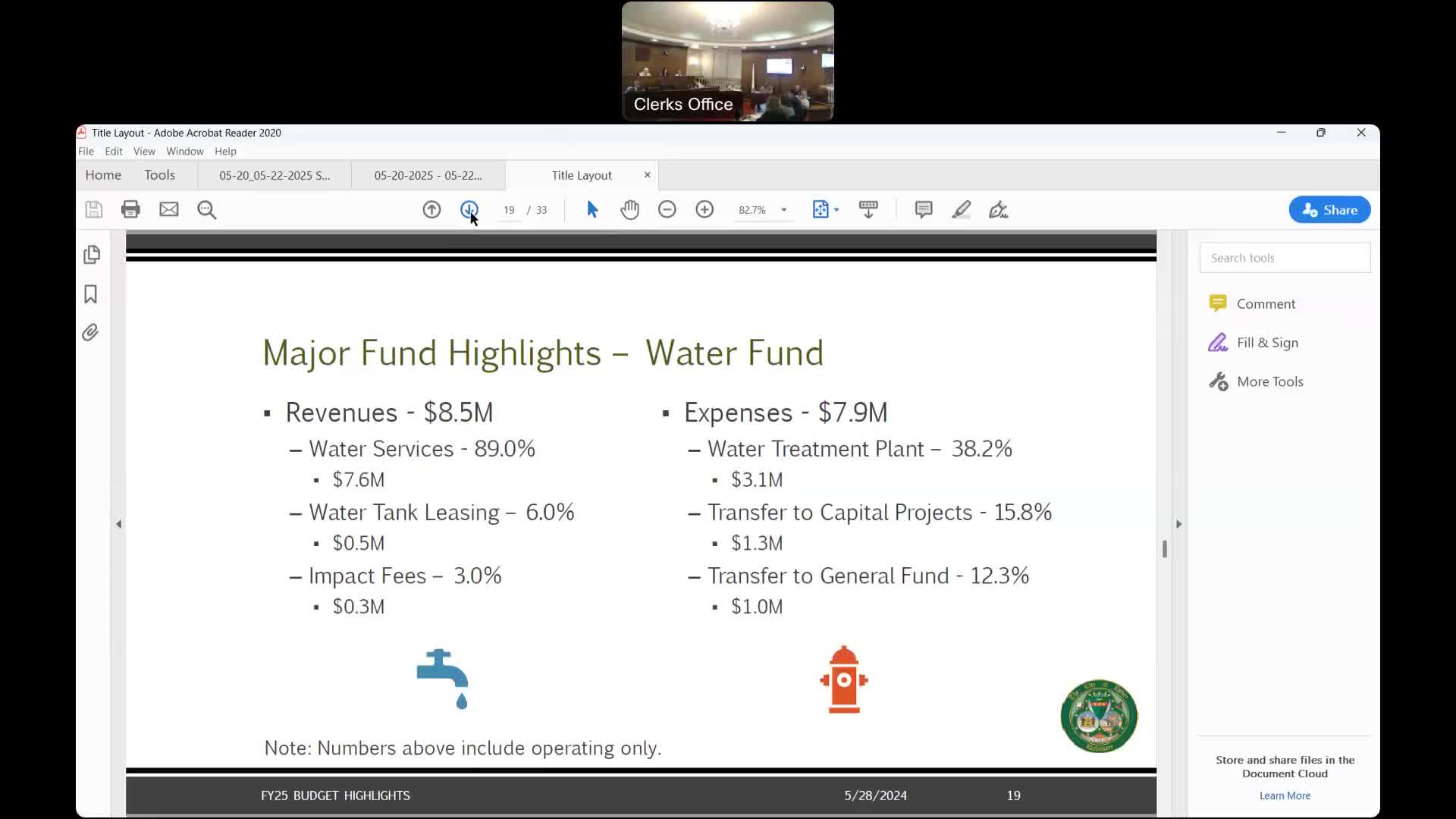
City water and wastewater officials told the council the FY2026 budget applies rate-study recommendations and will raise monthly charges modestly for typical residential users.
Jason Lyon, Director of Water and Wastewater Engineering Services, said the increases follow a third‑party rate study presented to council in March. He said the city forecasts an additional charge of about $1.98 per month for a typical residential water user and about $0.76 per month for wastewater; Lyon added that Kent County’s treatment charge — a pass-through cost outside city control — was recently approved at $1.64 per month. “So it's about $4.38 per month. So less than $50 a year for a residential customer here,” Lyon said, describing combined changes including the county treatment pass-through.
Lyon and city staff described ongoing efforts to reduce groundwater inflow into the sanitary system (I&I). Lyon said the city recently finished a roughly $1.3 million influent filtration/lining project that is expected to reduce infiltration and that impact fees must be used only for growth-related capital projects.
On capital and one-time funds, Lyon said about $4.2 million in American Rescue Plan Act (ARPA) funds were used on water projects, “primarily the water main replacement on State Street and then a new water production well,” and that the ARPA allocation has been largely expended. He cautioned council that some revenue streams (state and federal grants) were not built into the FY2026 budget because of uncertainty.
Officials noted wastewater treatment charges are volatile and vary with rainfall: “If it's a dry year...we don't have to spend as much when it gets treated,” Lyon said, referring to Kent County billing that depends on volume of flow.
Councilmembers asked for clarifications on chemical-treatment budgets. Lyon said the city budgets roughly $342,000 per year for chemicals across water treatment, with fluoride comprising “about 20% of that,” which he estimated at roughly $70,000–$80,000 annually. Council members also discussed the city's comparative position on municipal rates; Lyon said Dover ranks among the lower-cost municipalities in the study and will remain near the lower end even after the increases.
This topic was presented as part of the FY2026 budget review; no rate ordinance was adopted during the hearing.