Get Full Government Meeting Transcripts, Videos, & Alerts Forever!
Get email alerts on the Budget topic
No spam. Unsubscribe anytime.
Dover manager presents FY2026 budget without property tax increase; $6.7M general-fund gap identified
Summary
City Manager Dave Huggins presented a proposed FY2026 budget that holds the property tax rate steady, increases capital spending and carries a roughly $6.7 million gap in the general fund that would be covered by carryover funds, while enterprise funds show mixed results.
City Manager Dave Huggins presented the proposed fiscal 2026 budget at a May budget review hearing, saying the plan does not recommend a property tax increase for the coming year and relies on carryover funds to cover a projected general-fund shortfall.
Huggins told the council the general fund faces an estimated $6,700,000 gap between revenues and expenses and that the city balanced that gap with carryover money rather than dipping into reserves. “If we were to try and simply match revenues and expenditures on the general fund, it's about a $6,700,000 deficit,” he said. He said the budget does not use reserve funds to balance operations.
Huggins emphasized labor costs as the primary driver of higher expenditures: “Labor alone, increased almost $5,000,000, and that's a function of the union contracts.” He said the administration included a 4% increase for nonbargaining employees in the proposal and noted that several recently negotiated union contracts are increasing personnel costs and narrowing pay differences between bargaining and nonbargaining staff.
The proposed budget increases the capital program and defers some projects, leaving a capital program “significantly larger this year.” Huggins said some capital items were delayed to manage costs but that utilities and facilities needs could not be indefinitely postponed.
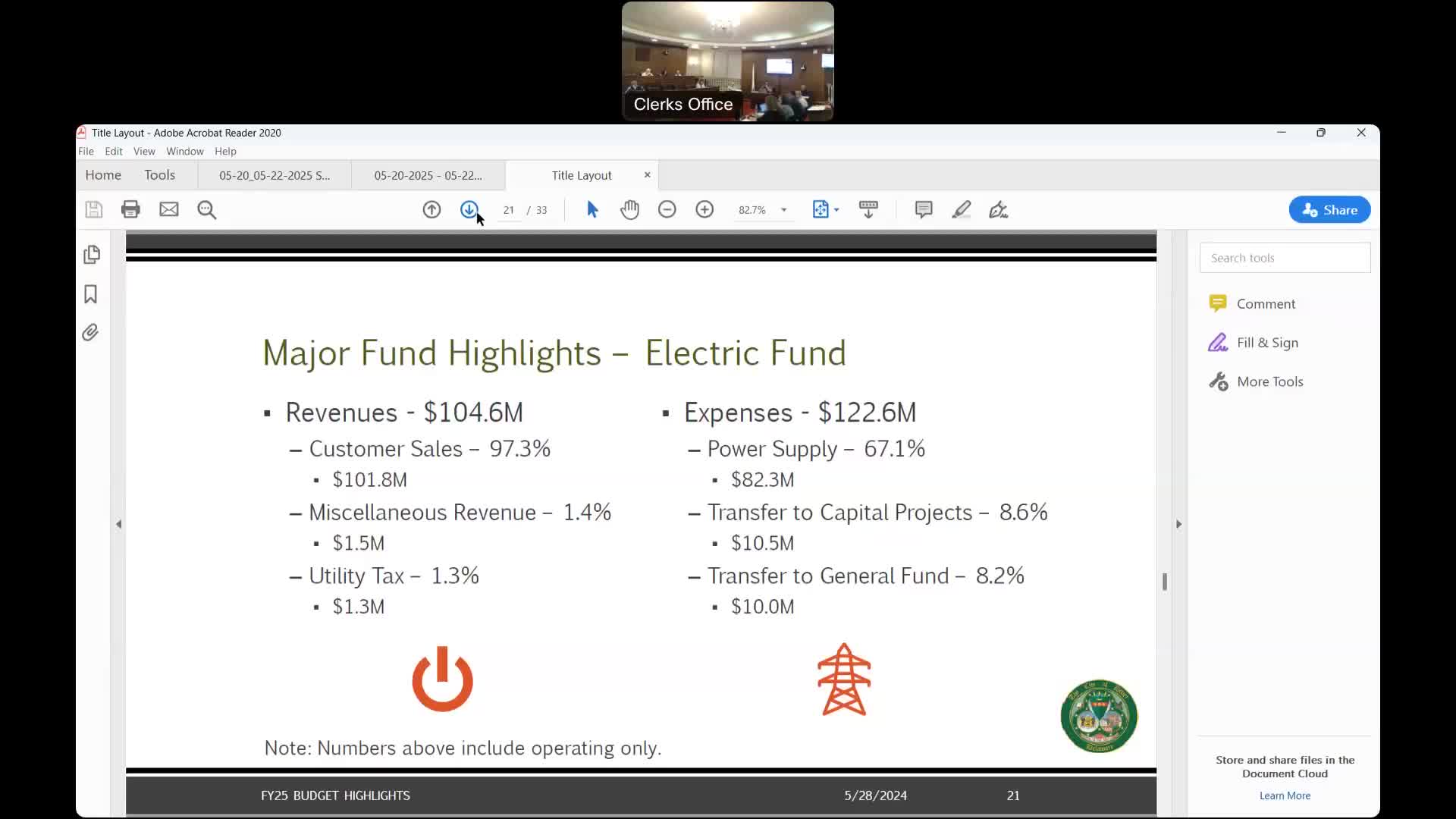
Huggins described revenue assumptions: the budget includes rate-driven increases in electric, water and wastewater based on recent rate studies; no one-time funds or reserve draws were used to balance the budget; and transfers from enterprise funds account for a significant share of general fund revenue. He also said stormwater is budgeted in the general fund this year rather than as a separate enterprise fund.
On risk factors, Huggins said federal and state grant assumptions were conservative because of ongoing legislative uncertainty and that inflation, tariffs and continued high interest rates add uncertainty to costs. He also highlighted that some energy wholesale prices fell recently and helped electric costs, but noted the electric fund is substantially below previous fund balances.
The council adopted the meeting agenda at the start of the session. At the end of the hearing the council voted to recess the budget hearing and resume the process the next day for further consideration.
Meeting context: the presentation included department briefings, revenue and expenditure charts, and discussions of staffing, enterprise funds, capital investments and contingency planning. No final adoption of the FY2026 budget occurred during this hearing; the presentation was for review and direction.