Get Full Government Meeting Transcripts, Videos, & Alerts Forever!
Get email alerts on the Frontage Policy topic
No spam. Unsubscribe anytime.
Resident urges rethink of piecemeal frontage improvement policy during public comment
Summary
A licensed civil engineer told the council that Newcastle’s frontage-improvement policy — which places costs of undergrounding overhead power and constructing sidewalks primarily on developers or individual parcel owners — is impractical and economically inefficient when implemented parcel-by-parcel along long corridors.
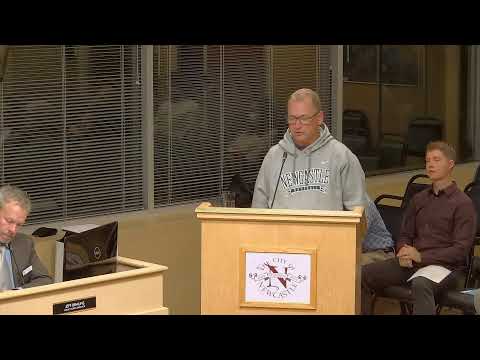
Newcastle — During public comment on June 17, resident Harvinder Singh, a licensed civil engineer representing the Ventry neighborhood, urged the council to reconsider the city’s frontage-improvement policy, arguing that piecemeal implementation of undergrounding overhead power and sidewalk construction would be infeasible and costly along long corridors.
Singh illustrated his concerns with Southeast May Creek Park Drive, saying the segment inside city limits runs about 1.75 miles (approximately 9,200 feet). Under current frontage rules and typical lot frontages of roughly 125 feet, he estimated roughly 75 separate construction “segments” would be required to complete undergrounding and sidewalk improvements parcel-by-parcel. Using bid estimates he obtained, Singh estimated the per-segment cost at $125,000–$150,000, producing a corridor total in the range of $9.3M–$11.2M (not accounting for inflation), and argued the piecemeal approach could take decades and cause repeated disruption to residents.
Singh suggested that a coordinated, larger-scale approach (for example, constructing continuous half-mile segments to realize economy of scale) could reduce total cost substantially and shorten the construction schedule; he offered to assist staff in discussing alternatives.
Council and staff response The city manager and public works director were present for the meeting and staff noted they would follow up; no council action was taken at the meeting on the city’s frontage policy. Singh’s comments were entered into the record for council consideration and staff follow-up.
Details offered by the speaker Singh estimated a realistic corridor completion timeline of 20–50 years under the current piecemeal approach and urged the council to evaluate alternatives that reduce cumulative cost, traffic disruption and repeated construction impacts along residential streets.