Get Full Government Meeting Transcripts, Videos, & Alerts Forever!
Get email alerts on the Budget Taxation topic
No spam. Unsubscribe anytime.
Commission reopens budget second reading; staff presents three tax-rate scenarios amid a large reappraisal
Summary
City staff presented three budget scenarios that differ by property tax revenue and projected use of fund balance as the commission resumes a tabled second reading during a reappraisal year; the certified municipal tax rate and county changes were discussed and residents spoke during the public-comment period.
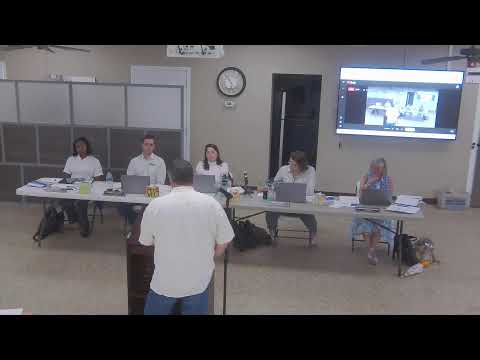
The Red Bank City Commission resumed a work-session discussion on June 17, 2025 about the budget ordinance that had a tabled second reading, with staff presenting three scenarios that differ mainly by property tax revenue and the projected use of fund balance.
Finance staff framed the conversation as an amendment to a budget ordinance that previously passed first reading. The three scenarios in the staff packet include: Scenario 1 (no change from first reading) with an FY ’26 tax-rate projection of 94.164¢ and a projected use of fund balance of $415,675; Scenario 2 with an approximate 1% additional tax increase (overall ~6% property tax increase), a 95¢ projected rate and $363,175 use of fund balance; and Scenario 3 with an approximate 4% additional increase (overall ~9% property tax increase), a 98¢ projected rate and $205,675 use of fund balance. Staff repeatedly advised against amending the second reading to exceed the revenue embodied in Scenario 3.
Staff and commissioners emphasized complications from the city’s reappraisal. The packet reports a median appraisal change across Red Bank’s roughly 5,253 parcels of 59.05%, and a certified municipal tax rate of 0.8968 (89.68¢) provided for use in state reporting. Countywide action was also discussed: Hamilton County’s certified rate was cited in the transcript as 1.5157 (down from about 2.23), and county-level changes could raise many residents’ county tax bills despite the city’s rate changes.
Commissioners and staff noted that the main practical difference among scenarios is the use of fund balance to protect the city’s long-term position for a forthcoming capital program. Staff said millions of dollars of capital needs are anticipated over the next five to 20 years — multimodal projects, park development, recapitalizing the public works building and other capital investments — and preserving fund balance would make the city better positioned to pursue grant-competitive concept development and match funding.
A vice mayor and other commissioners ran hypothetical tax-bill illustrations for a median-value household and for individual properties whose appraisals rose more or less than the median. They emphasized that because assessment increases vary widely by parcel, the net dollar effect on an individual property owner can differ sharply: in one example in the record, a median household’s Red Bank tax bill would rise by roughly $30 a year under the highest scenario, while another resident with an 80% increase could see a larger county-tax increase.
Public comment during the work session touched the subject. Josh Brandon of Greater Chattanooga Realtors provided housing-market figures, noting inventory in Red Bank doubled year-over-year and median sales price declined in the sampled month; another resident, Fred Ferguson, opposed any tax increase and questioned spending priorities. The commission paused the budget conversation at 5:45 p.m. to move to citizen comments; the budget discussion was scheduled to continue during the regular meeting at 6:00 p.m.
Staff also described an option for a more extensive tax-rate change (a $1.00 tax rate) that would eliminate use of fund balance, but noted that reaching that rate after first reading would require rescinding the current ordinance, passing a continuation budget, and restarting the budget process on a compressed timeline.
No final amendment or vote on the second reading was recorded in the transcript from the work session portion; staff indicated suggested amendments would be prepared for the commission to adopt at second reading during the regular session.