Get Full Government Meeting Transcripts, Videos, & Alerts Forever!
Get email alerts on the Tax Increment Finance topic
No spam. Unsubscribe anytime.
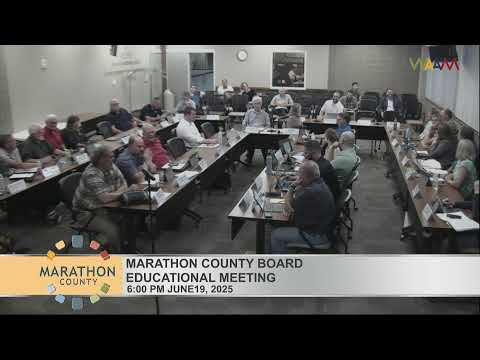
Marathon County debates TIF oversight; public commenter calls current practice "out of control"
Summary
A public commentator urged the county board to strengthen guidance for the county's representative on tax-increment districts (TIDs). Supervisors debated the resolution's language on required considerations and the meaning of a proposed 38-year payback.
A Marathon County resident criticized local use of tax-increment financing and urged supervisors on June 19 to adopt stronger county guidance for the county's representative on TID joint review boards.
Peter Weinshank, a resident of Edgar, told the board that "Marathon County TIF right now is pretty much out of control," and urged board members to reject or amend Resolution 36-25, which had been drafted by the Extension Education and Economic Development Committee. Weinshank said his preferred language would direct the county finance director to vote for or against TID proposals based on the Department of Revenue's joint review board best practices and to require any new TID to repay taxpayers within 38 years.
Weinshank noted several specific figures: he said "10% of all county property is now in TIF" and that "in 2023, the TIF tax paid by the owner of an average price house in Marathon County is $347.22." He criticized the committee's version of the resolution as omitting two elements he considered crucial'a mandatory best-practices vote and an express requirement that new TIDs repay taxpayers within 38 years.
Supervisors debated the proposal at length. Supervisor John Robinson said there appears to be confusion about the 38-year language and observed that state law allows creation of a TID for 27 years with a three-year extension and further legislative action in some circumstances: "You can't have a TIF for 38 years," Robinson said, arguing the county should clarify the resolution's intent. Supervisor Chris Marshall noted a separate incentive effect: development inside a TID can increase a municipality's net new construction and thus its levy limit, which can create a perverse incentive to develop inside TIDs rather than outside them.
Supervisor Jean Marash, who represents the county on joint review boards, told the board that she used the committee guidance when she voted at a June 12 review-board meeting: she described voting yes on an $8.5 million amendment for one TID where staff concluded the project aligned with county goals for housing and economic growth; she said she voted no on other proposed amendments when the project did not demonstrate additional housing, jobs or property-value gains.
Several supervisors urged working through the language before final county-board action so the county representative has clear direction. Supervisor Fiffrick and others also defended TIDs as an important economic-development tool when used judiciously, saying they can enable projects that would not happen otherwise.
What happened next: Resolution 36-25 remained before the board for consideration; at the June 19 meeting supervisors discussed changes including clarifying the 38-year language and instructing the finance director on how to weigh Department of Revenue best practices when voting. No final board vote was recorded on the floor that evening.
Ending note: Supervisors asked staff and committee chairs to reconcile the resolution language and return to the board with clarified wording ahead of Tuesday's meeting.