Get Full Government Meeting Transcripts, Videos, & Alerts Forever!
Get email alerts on the County Budget topic
No spam. Unsubscribe anytime.
Marathon County leaders lay out 2026 budget process, warn levy growth tied to net new construction
Summary
County leaders detailed the 2026 budget kickoff on June 19, explaining levy limits tied to net new construction, the difference between operating and capital budgets, and the role of standing committees in developing priorities and fees.
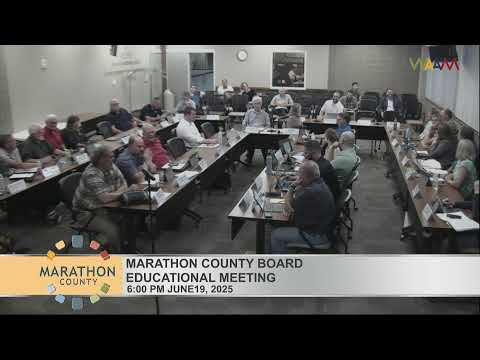
Marathon County Board leaders and staff on June 19 outlined the county's 2026 budget development process and urged supervisors to engage through standing committees as staff prepares the administrator's proposed budget.
The presentation, led by the county administrator and finance director Sam, explained key concepts the board will use as it frames priorities: property tax levy versus levy rate, the role of equalized value and net new construction, distinctions between operating and capital budgets, and fund-balance designations for working capital and CIP rollover.
Sam, the county finance director, told supervisors that "our property tax levy is about 57, almost $58,000,000." He emphasized Wisconsin's levy limits and said the county's ability to increase the levy is tied to net new construction rather than inflation: "we have very strict levy limits. Our property tax levy'the amount of tax we can collect'can only increase by our net new construction value." The presentation noted recent net-new-construction rates ranged roughly between 1.59% and 2.32% and that last year's estimate (1.78%) represented roughly $900,000 of additional levy capacity.
The administrator explained equalized value and assessment differences and showed that the county's equalized value used for apportionment is north of $17 billion; she noted Tax Incremental District (TID) valuation is excluded from the apportionment until a TID closes. She also described the county's practice of budgeting conservatively for sales-tax revenue (historically estimating about $16 million) and explained how CARES/ARPA infusions temporarily increased CIP rollover funds in recent years but will not be a recurring source.
Presenters stressed the difference between operating and capital budgets and the limits on borrowing for operations in Wisconsin: capital projects may be funded by borrowing and placed outside the operating levy limit, while borrowing to fund operations is not permitted. The county also highlighted a rollover policy for unused CIP funds and the importance of a five-year CIP to anticipate large projects and to time borrowing when other debt service obligations drop.
Committee chair Supervisor John Robinson and staff told supervisors that the most direct influence board members have on the budget is through standing committees, which review mandatory and discretionary program lists, fees for service ("public charges") and capital requests. "Not every dollar in the budget is created equal," the administrator said, noting some programs are largely grant-funded while others are mostly levy-supported.
Staff outlined the timeline: standing committees will review program and fee materials in coming weeks; the administrator will present a proposed budget to the full board in late September; the county sets a preliminary budget for public hearing in October with final adoption in November. The administrators asked supervisors to provide policy direction early, including priorities on employee compensation, health insurance, new positions and capital-reserve use.
The presentation also cited federal- and state-level uncertainties that could affect the budget, including potential federal changes to Medicaid and SNAP and the state budget'noting the county's fiscal year (Jan. 1 start) is out of phase with state and federal fiscal years. Staff said they will bring a proposed fund-balance policy and an audit report to the board in July to clarify restricted versus discretionary fund balances.
Less-critical details and next steps: the finance staff will deliver budget assumptions and priority frameworks to HR/Finance and standing committees; the county's five-year CIP will be before HR/Finance next week; and committees were urged to submit questions in advance of meetings so staff can provide program-specific levy impacts.