Get Full Government Meeting Transcripts, Videos, & Alerts Forever!
Get email alerts on the City Budget topic
No spam. Unsubscribe anytime.
Ogden City Council adopts FY‑26 budget, approves CIP and utility transfers and OKs pay increases
Summary
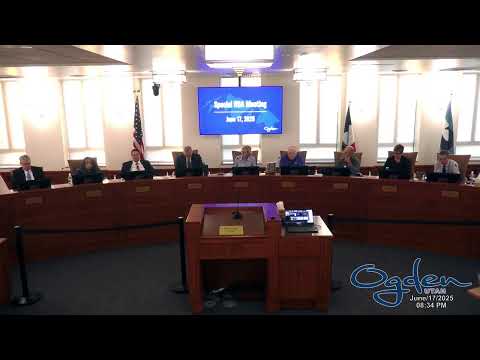
Ogden City Council adopted the final fiscal 2026 budget and the city’s five‑year capital improvement plan on June 17, while approving planned enterprise‑fund transfers and a combined 2.97% cost‑of‑living increase and a 2% merit pool for city employees.
Ogden City Council adopted the final fiscal 2026 budget on June 17, approving the city’s five‑year capital improvement plan, retaining planned utility‑to‑general‑fund transfers and approving employee pay adjustments that combine a 2.97% cost‑of‑living adjustment with a 2% merit pool.
The council’s final vote approved the ordinance establishing the FY‑26 budget, the capital improvement plan and the staffing and salary schedules; it also amended Schedule A‑1 to move $8,000,000 of ARPA‑designated capital funds into an “allocated future projects” account rather than the specific CIP line items proposed by administration.
The action matters because it sets Ogden’s spending and capital priorities for the next fiscal year and keeps in place the city’s longstanding practice of transferring a portion of utility revenues to the general fund, a practice that residents and council members debated at length during the public hearing.
Council and staff said the budget preserves ongoing projects and new capital work while also funding compensation adjustments. Coralie (staff member) opened the council’s budget items with a year‑end budget opening that recognized roughly $4,689,300 in additional revenues and grants for FY‑25, including donations for Marshall White Center swim lessons and several grants for park and playground projects.
Steve Burton, the administration presenter for the capital improvement plan, told the council the CIP lists 92 projects across five years with proposed total project funding of about $249.3 million and first‑year funding in FY‑26 of roughly $29.7 million. Burton said 27 projects are new, 42 are perpetual maintenance projects and the packet shows 1st‑year funding broken down by department and funding source.
Finance staff presented the routine enterprise‑fund transfer item required by state notice law. Janine Allersmith (finance staff) explained the transfers are intended to spread the cost of municipal services and are based on enterprise budgets; the proposed transfers for FY‑26 were about $3,500,000 from water, $1,800,000 from sanitary sewer, $800,000 from storm, and $935,000 from refuse, for a total just above $7,000,000. Allersmith summarized a city‑commissioned analysis by the city’s financial advisors, LRB, and said the study concluded "the increase would at least 33% would be required in property tax revenue to the taxpayers to replace" the transfers if they were eliminated.
Public comment focused heavily on the transfers and on high residential bills. Several residents asked the council to study alternatives and to audit utility billing and meter practices. Joseph DeGraffenreid told the council, "I pay about a $123 a month for water...to see the water bill to property tax ratio be so dramatic, it's just it feels unreasonable to me as a resident." Other commenters described high base charges tied to meter size, and urged the city to examine whether some commercial meters in residential use should be reclassified. Council members asked staff to return with more detail; staff said some items (meter resizing, dispatch line issues) will require utility engineering follow‑up rather than immediate policy change.
On compensation, the council approved the administration’s proposed 2.97% cost‑of‑living adjustment for all employees and approved a 2% merit increase for eligible non‑sworn staff (public safety uses a separate step program). The council’s work session discussions had raised the merit proposal from 1.5% to 2%, a change the council incorporated in Schedule A‑1. Glenn (staff member) said the additional 0.5% raises the cost of pay increases by roughly $193,007.50 as reflected in the final Schedule A‑1 and that carryover salary and benefit savings of roughly $2.0–2.2 million would fund the increases.
A portion of the council discussion addressed the administration’s recommended use of $8,000,000 in ARPA funds. The mayor and administration had proposed allocating $5,000,000 toward acquisition or related costs for the Keesel (county correctional) facility building, $2.5 million for Union Station campus improvements and $500,000 for an all‑abilities park. After debate about negotiating leverage and development priorities the council approved an amendment to move the $8,000,000 into an allocated future projects fund in the CIP rather than committing it to the specific line items the administration initially proposed. The motion passed 5–2 (Aye: Graff, Ritchie, Blair, Chibburka, Chair White; Nay: Myers, Vice Chair Hyer).
Other formal actions during the meeting included adoption of a year‑end budget ordinance and adoption of the capital improvement plan as presented; roll‑call votes on those ordinances were unanimous. Council members also approved the salary schedules and the staffing document that together implement the FY‑26 personnel changes in the adopted budget.
Discussion vs. formal action: The council held multiple public hearings (CIP, enterprise transfers, compensation, final budget). The enterprise‑transfer hearing required notice per state law but no separate action; the transfers are implemented as part of the final budget ordinance. Several public commenters urged audits or meter changes; staff said those were questions for the water utility and engineering and would be returned to council with technical recommendations rather than being adopted immediately.
The council directed several follow‑ups: staff to provide additional detail on meter sizing and base‑rate options, to explore whether some properties with commercial meter rates but residential use can be reclassified, and to report on the feasibility and cost of an audit of utility billing and emergency‑dispatch infrastructure. No new policy was adopted on those items at the meeting.
What’s next: the FY‑26 budget and CIP will guide the city’s work through the coming year; staff are to return with implementation details on utility billing concerns and with additional detail on the ARPA‑funded projects if future council action reassigns the $8 million appropriation.
Quotations used in this story are drawn from the council meeting transcript and are attributed to the speakers who spoke on the record.