Get Full Government Meeting Transcripts, Videos, & Alerts Forever!
Get email alerts on the Historic Preservation topic
No spam. Unsubscribe anytime.
Nonprofit developer asks Glynn County for $800,000 pledge to unlock Rise Grizzly renovation grants
Summary
Presenters seeking a local commitment said the historic Rise Grizzly campus needs gap funding to advance architectural plans and construction; the developer described project scope, tax credit targets and a request for an $800,000 county commitment plus reimbursement for early milestone costs but no formal county action was taken at the meeting.
The Glynn County Board of Commissioners on June 17 received an update on the Rise Grizzly historic renovation project and a request for a formal $800,000 commitment from the county to strengthen grant and tax‑credit applications.
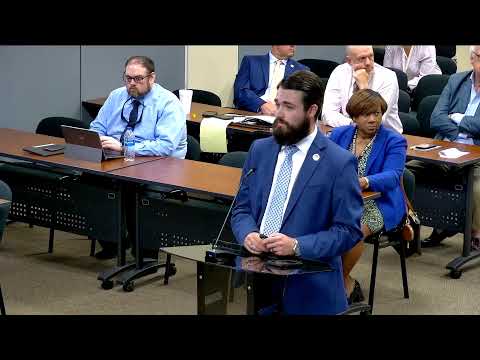
Theresa Hamilton, representing the project, introduced Mitchell Davenport, the developer engaged to close and manage construction financing, who described the project scope, risk‑mitigation work completed to date and remaining steps to get the project to construction. Davenport said the project team has completed a Phase I environmental review and a structural assessment, removed asbestos tile from a second floor and prepared schematic designs and cost estimates.
Why it matters: Presenters said Rise Grizzly will repurpose a large historic campus in a low‑income census tract as affordable office and service space for nonprofits, training and a small‑business kitchen incubator. The team argued that local government support will bolster the project’s competitiveness for state and federal grants, historic tax credits and new markets tax credit allocations.
Financial and schedule details provided by the developer: - Hard construction estimate shown to commissioners: about $18,345,131 (the presentation stated this figure includes a 14% contingency). Davenport said a current rounded total development budget is about $22,100,000. - Grants and equity: Presenters said they have received or been awarded about $1,649,832 in grants to date and have applied for over $26,000,000 in additional grant funding. The team also reported a pending National Park Service historic tax‑credit Part 1 approval (NPS project number cited in the presentation) and that a Part 2 application had been submitted on May 29 for a 2027 tax‑credit reservation. - Local ask and near‑term reimbursement: The presenters asked for the county’s formal commitment to an $800,000 local contribution (Commissioner Booker previously designated $800,000 for RISE). Davenport also requested reimbursement of approximately $400,000 for early milestone costs to allow the nonprofit to proceed to exploratory demolition, finalize architectural plans and secure additional capital and tax‑credit buyers. - Timeline: If the county is amenable and an MOU is finalized at a near meeting, the developer said exploratory demolition could be ordered immediately, design completion could take four to six months, contractor mobilization about three months, and an 18‑month construction period would put a potential delivery around September 2027.
Discussion and context: Commissioners and staff asked for detail on prior spending, reimbursement mechanics and revenue assumptions. Davenport said roughly $460,000 in private donations has been raised to date, that the project assumes some rental income from nonprofit tenants (presentation listed about 23,300 rentable square feet of office/school space and roughly 50,000 gross square feet overall), and that many grant approvals and tax credit buyers are contingent on seeing local government financial support.
Presenters emphasized the project’s community uses — nonprofit offices, Head Start and training space, a possible museum or gift shop in the former library building, and a kitchen incubator to support small food businesses. Davenport said the project team is pursuing new markets tax credits to provide equity and low‑interest loans and that showing local financial commitments strengthens grant and investor confidence.
No formal county vote or appropriation was recorded during the meeting. Commissioners said they would continue reviewing materials; a county official noted the city commission had previously voted to enter an agreement to support the project but that document had not yet been executed.
Ending: Project leaders asked for a near‑term MOU and financial commitment so they can complete milestone work, attract tax‑credit investors and schedule construction; county staff and commissioners requested additional documentation and clarity on reimbursement timing and grant conditions before approving funds.