Get Full Government Meeting Transcripts, Videos, & Alerts Forever!
Get email alerts on the Zoning topic
No spam. Unsubscribe anytime.
Sweetwater County commissioners open 45‑day comment period on zoning language changes for campgrounds and telecom towers
Summary
The Board of County Commissioners approved a notice of intent to amend sections of the 2015 Sweetwater County Zoning Resolution to add standards for commercial campgrounds, telecommunications towers (including stealth designs), and several definitions; the Planning and Zoning Commission recommended approval 4–0.
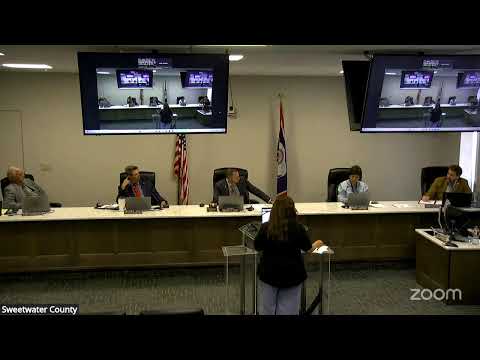
The Sweetwater County Board of County Commissioners on June 17 approved a notice of intent and opened a 45‑day public comment period to amend the 2015 Sweetwater County Zoning Resolution to add standards for commercial campgrounds, telecommunications towers and related definitions.
County Land Use Director Eric Bingham outlined the package, saying it would add a use chart entry for commercial campground facilities, campground standards for sites with and without utilities, and detailed submission and siting priorities for wireless communication facilities, including co‑location and “stealth” towers. “When it gets to a certain height, permitted in ag, at the bottom there when it’s greater or equal to 200 feet,” Bingham said, noting FAA lighting requirements at higher heights. He also described setbacks, a 110% setback standard for towers, and visual‑impact and discontinuance rules for abandoned towers.
Why it matters: the amendments create clearer rules for where and how RV campgrounds and cellular infrastructure may be placed in the county and establish objective criteria previously absent from county code. Bingham told commissioners the draft also codifies a definition for motocross/motorized tracks to distinguish backyard jumps from commercial tracks that cause larger surface disturbance and dust problems.
Key details: the campground standards differentiate dependent (tent) and independent (RV) sites, set minimum parcel sizes (five acres without utilities; two acres with utilities), campsite sizes (300 sq ft for tents; 1,800 sq ft for RVs without utilities; 1,350–1,800 sq ft with utilities), setbacks, screening and fire‑safety plan requirements, and DEQ compliance for sanitary systems. For wireless facilities the draft lists siting priorities (co‑location, distribution antenna systems, rooftop/stealth options), sets a minimum six‑foot fence, requires compliance with FCC/FAA lighting, and allows reduced setbacks for camouflage/stealth designs such as tree or bison disguises. The Planning and Zoning Commission certified the language 4–0 and recommended approval to the board.
Process and next steps: the hearing on June 17 was a “notice of intent” only; commissioners voted unanimously to adopt the notice of intent and open the 45‑day comment period. Bingham said the county will accept written public comments during that period and then return to the board for final adoption after review. He confirmed amateur radio towers are exempt from county regulation under federal law.
Quotes and attribution: “We went in there and simplified the regulations with as far as campgrounds go and also with telecommunication towers,” Eric Bingham said. Bingham also told commissioners, “Stealth wireless communications is a siting priority,” describing examples such as towers disguised as pine trees.
Ending: The county will accept public comments for 45 days; staff expect to bring any recommended changes back to the Planning and Zoning Commission and the Board of County Commissioners for final action after the comment period closes.