Get Full Government Meeting Transcripts, Videos, & Alerts Forever!
Get email alerts on the Immigration Enforcement topic
No spam. Unsubscribe anytime.
Committee reviews FAQ on immigration enforcement; MNPD, Metro Legal and DEC clarify authorities and procedures
Summary
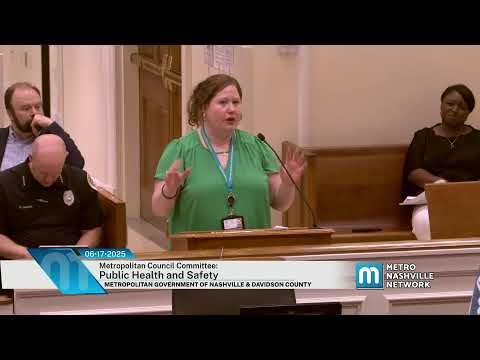
The Public Health & Safety Committee of the Metropolitan Government of Nashville and Davidson County reviewed a staff FAQ and written responses about immigration enforcement, receiving clarifications from MNPD, Metro Legal and DEC on agency authority, helicopter use and extra-patrol procedures.
The Public Health & Safety Committee of the Metropolitan Government of Nashville and Davidson County on a regularly scheduled meeting reviewed a staff FAQ and written responses about a special-called committee meeting on immigration enforcement chaired by Councilmember Porterfield. The packet summarized what MNPD, Metro Legal and the Department of Emergency Communications (DEC) could and could not do during immigration enforcement activity and answered specific operational questions raised by council members.
Why it matters: The exchange clarified the limits of local authority when federal or state immigration enforcement operates on public streets, described how Metro will handle public records requests tied to those events and spelled out current DEC procedures for extra-patrol requests — information council members said they needed after recent enforcement activity and public concern.
The MNPD response said the department has no authority to prevent the Tennessee Highway Patrol (THP) or U.S. Immigration and Customs Enforcement (ICE) from conducting enforcement on non–state-owned property or public streets. Deputy Chief Gilder noted MNPD has two helicopters and described typical staffing on flights: “there’s a pilot that’s piloting the aircraft, but oftentimes, they have a flight officer that rides along with them that helps engage in communications with ground and whatnot.” He said the two launch times cited in the packet were 12:25 p.m. (18 minutes) and 2:40 p.m. (6 minutes) and that “the total cost, including staff cost, was approximately $260.”
MNPD told council members that immigration enforcement is a federal function and that MNPD “plays no role in that process” but that officers are required to report contact with immigration officials under the mayor’s executive order. The department’s written responses noted there will be no new departmental guidelines beyond existing policies. MNPD also said it will provide public records associated with incidents “to the extent that there are any public records associated with these incidents in MNPD possession…in accordance with state law.”
Metro Legal answered a series of statutory questions. The memo cited Tennessee Code Annotated section 55-9-107(a) on window tinting and the subsection exception for vehicles bearing commercial or government service license plates used for law enforcement purposes “for those windows rearward of the front doors.” Metro Legal wrote that the city does not have authority to stop federal immigration enforcement and cautioned that interfering with federal enforcement could be a criminal act. The memo also summarized THP authority, citing THP’s statewide jurisdiction and the existence of memoranda of understanding that permit certified THP officers to assist with federal immigration enforcement, and it noted THP has entered into a 287(g) agreement to assist federal authorities.
The legal memo gave effective dates for sections of Public Chapter 1 as provided in the packet: sections creating new criminal offenses for local officials were described as taking effect 07/01/2025, and sections creating new restrictions around driver’s licenses and photo identification cards were listed as taking effect 01/01/2026.
On operational questions routed to DEC, the packet said callers may request extra police presence by phone (866-286-8600), 311 or the Hub Nashville website/app. The department’s response stated there is currently no procedure to elevate a particular extra-patrol request above others and that such requests are treated as low-priority, non-immediate requests that MNPD fills at its discretion. Council members pressed that practice; Councilmember Greg said in committee that treating extra-patrol requests as uniformly low priority “seems counterintuitive” and asked for changes for future volatile situations.
Councilmembers asked follow-up questions in the meeting. Councilmember Prepte asked about helicopter staffing and cost; Deputy Chief Gilder answered that he would confirm whether a flight officer rode on the particular flights cited and reiterated how flight-hour costs are calculated. Pro Tem Sepulveda asked Metro Legal to re-read the window tinting explanation; Metro Legal’s answer referenced the statutory exception for law enforcement vehicles but said the office would follow up on enforcement questions, including whether federal vehicles would be subject to state window-tint rules.
What the committee did not do: The meeting recorded no new policy or ordinance changes. Committee members requested follow-up clarifications from MNPD and Metro Legal (for example, whether federal vehicles are subject to state tint rules and whether a flight officer was aboard the referenced flights). Committee members also asked DEC for written clarification of its extra-patrol prioritization and for written guidance about elected officials’ rights when interacting with federal agents; the chair directed those follow-ups be added to the committee’s list.
The committee’s discussion combined written answers provided in the packet with in-room clarifying questions; no formal votes were taken on immigration-related policies during this meeting.
Ending: Committee members said they want continued written clarifications from MNPD, Metro Legal and DEC and indicated they expect further discussion at future meetings or in follow-up briefings.