Get Full Government Meeting Transcripts, Videos, & Alerts Forever!
Get email alerts on the Land Use Rezoning topic
No spam. Unsubscribe anytime.
Huntersville board denies rezoning for Everett Keith subdivision after concerns over plan fit and timing
Summary
The Huntersville Board of Commissioners voted to deny rezoning petition R24-07 (Everett Keith), citing conflicts with the town's 2040 plan and the Eastfield Road small area plan, outstanding connectivity and design issues, and limited time for public review of late changes.
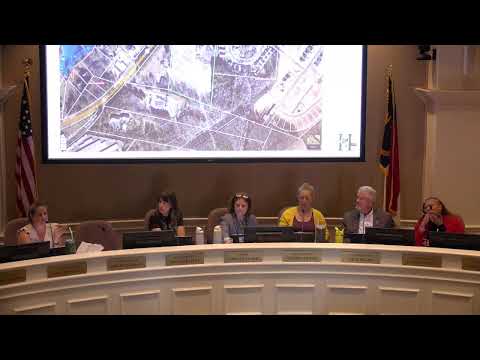
The Huntersville Board of Commissioners on June 17 denied rezoning petition R24-07 for a proposed 106-acre Everett Keith residential subdivision, saying the applicant's proposal did not align with parts of the Huntersville 2040 plan and the Eastfield Road small area plan and that late changes limited public review.
The board's motion to deny, which passed after a second, found the petition inconsistent with multiple land-use policies in the 2040 plan and with the Eastfield Road small area plan. Commissioners who voted to deny cited outstanding concerns about internal connectivity, residential design and transitions to adjacent neighborhoods.
Planning staff described the proposal as a 259-lot subdivision with an overall average density of about 2.44 units per acre, including 76 attached townhomes, 75 cottage-style single-family homes, and a mix of detached lots. Staff said the developer had agreed to spread eight attainable (affordable-for-sale) units across the site rather than clustering them, and to construct on-site multiuse paths and some greenway connections and park improvements. The application had been before the planning board, which recommended approval with abstentions.
In public comment, Christine Wallach urged the board to consider the size and design of the attainable units, saying the applicant appeared to have placed smaller units in a distinct building and that the floor area was substantially smaller than market units. She told the board, "I don't think that really satisfies the intent of the affordable and attainable housing goals." Jeff Locke, chair of the Huntersville Greenway, Trail and Bikeway Commission, asked that the developer ensure engineering for a bridge and path connections so the project would not block a regional Charlotte-to-Mooresville trail link through the site.
The applicant described multiple on-site amenities in its presentation, including pocket parks, a proposed 10-space parking lot and restroom building to support a town-dedicated park parcel, pickleball courts, and about 2.3 miles of multiuse paths connecting roughly 23 acres of urban open space. The applicant said it had revised plans since the public hearing to disperse the eight attainable units among the attached and cottage product types, reduced build-to lines, and added a phasing plan that would postpone construction traffic on Dogwood Lane.
Staff and the applicant also discussed several outstanding technical items: an off-site sewer agreement the developer must secure for the project to proceed, coordination with Duke Energy on alignment across a transmission corridor, and a speed-study/traffic-calming coordination with N.C. Department of Transportation for nearby Dogwood Lane. Planning staff noted significant topography and utility easements on the site that limit alley connectivity in some neighborhoods within the project.
Commissioners who opposed approval said changes introduced late in the process and abstentions at the planning board had reduced confidence that the public had adequate time to review the most recent materials. One commissioner said the proposal felt like "fitting a square peg in a round hole" despite changes made over the previous 18 months.
The board's vote denies the rezoning; staff and the developer may return with revised proposals or other options subject to future hearings and filings.
Less central to the vote, several speakers in public comment also urged broader environmental and recycling policy changes and expressed opposition to unrelated commercial expansion projects, but those items were not before the board for action.