Get Full Government Meeting Transcripts, Videos, & Alerts Forever!
Get email alerts on the Pavement Maintenance Funding topic
No spam. Unsubscribe anytime.
Public Works proposes $1.7 million pavement maintenance line, asks for $500,000 CIP supplement
Summary
Public Works told the County Commission the current $1.2 million annual pavement maintenance line is insufficient to meet the county's 2010 pavement-management cycle; staff proposed raising the contracted maintenance line to $1.7 million and supplementing it with $500,000 from the Capital Improvement Program for 2026 planning.
Public Works staff told the County Commission at a 4:00 p.m. work session that the county should increase its contracted pavement maintenance line from $1.2 million to $1.7 million and request a $500,000 supplement from the Capital Improvement Program (CIP) to keep up with a 2010 pavement-management plan.
The recommendation came from Chad, Public Works staff, who framed the request as part of preparing the 2026 budget. “We want to take the $1,200,000 and go to $1,700,000 in the budget line item for contract and maintenance,” Chad said, describing a proposal to supplement that increase with CIP funds as has been done in past years.
The issue matters because the department’s analysis shows the county has completed a 15-year cycle since adopting the 2010 pavement plan and is now falling behind on the maintenance cadence the plan envisioned. Under that plan, new asphalt would receive a chip seal once after 7–10 years, another chip seal 5–7 years later, and then a mill-and-overlay about five years after the second chip seal. Public Works calculated that maintaining that cycle at 2025 prices would require roughly $2.6 million annually; the current baseline has been $1.2 million since 2020.
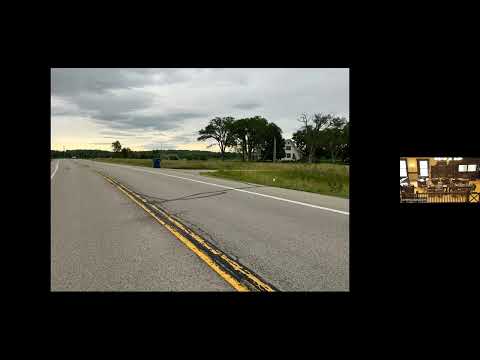
Public Works provided multiple illustrations and project histories to explain the tradeoffs between mill-and-overlay projects and lower-cost chip seal work. Chad explained that mill-and-overlay requires specialized milling equipment contractors typically operate and that chip seal — placing a tack asphalt layer followed by aggregate (Haydite) — is a lower-cost method intended to keep moisture out of the subgrade. “The whole point of either one of these options is always to seal up the road that’s underneath so that moisture can’t penetrate through the road and get into your subgrade,” Chad said.
The department’s historical accounting shows about $17 million spent on mill-and-overlay and $5 million on chip seal over a 15-year span (roughly $22 million total). Using present-day cost projections and road-volume categories, staff produced targets: on average about 15 miles per year of chip seal and 7.5 miles per year of mill-and-overlay to follow the 2010 cycle. Public Works also noted material-price volatility and supply disruptions that affected work in 2020 and other years.
Commissioners asked for clarity on the analysis and the proposal. “How do you make sure that this plan is best practice outside of Douglas County? Or do you talk to other counties… KDOT about what they’re doing?” Commissioner Kelly asked. Chad said the office follows KDOT specifications, industry conferences and supplier data and that the county’s approach is consistent with adjacent counties and national practice. He also credited prior staff with developing the 2010 plan and described the current work as a data-driven reassessment of that plan.
Staff identified candidate projects for the coming year: a proposed 10-mile mill-and-overlay corridor around Clinton Lake (from Lone Star turn up to Stull) and a chip-seal project on the east side of the county south of Eudora. Chad said the county maintains about 188 miles of asphalt roads and that there are about 76 miles carrying 1,500 vehicles per day or more, which drives heavier maintenance needs.
No formal vote or action was taken in the work session; commissioners and staff treated the presentation as informational. Commissioner Reid reminded attendees that “this is informational purposes only. We don’t take any action during work sessions,” and the staff presentation was described as preparation for formal budget requests and CIP conversations that will come before the commission in later meetings. The department plans to include the increased contracted-maintenance line and a $500,000 CIP supplement in next year’s budget materials for formal consideration in the commission’s regular budget process.
The presentation also clarified scope limits: the maintenance request covers paved roads only and would not convert gravel or township rock roads to paved surfaces; such conversions would be a separate CIP-level decision. Chad noted that converting rock roads to pavement is a substantial, distinct investment and that paving conversions would be funded and planned through CIP rather than the maintenance line.
Next steps: Public Works will include the $1.7 million contracted-maintenance request and the $500,000 CIP supplement in upcoming budget materials. The commission will review those requests in the formal budget and CIP hearings scheduled later this year.