Get Full Government Meeting Transcripts, Videos, & Alerts Forever!
Get email alerts on the Preservation And Capacity topic
No spam. Unsubscribe anytime.
Southborough committee discusses preserving naturally occurring affordable housing, staffing, and grant opportunities
Summary
Committee considered tools to preserve naturally occurring affordable housing (NOAH), the potential for town acquisition or incentives, staffing needs for the Housing Trust, and pursuing Housing Choice designation to leverage state resources.
The Housing Trust discussed preservation strategies for naturally occurring affordable housing (NOAH), possible incentives or acquisitions, and capacity-building measures for the Trust.
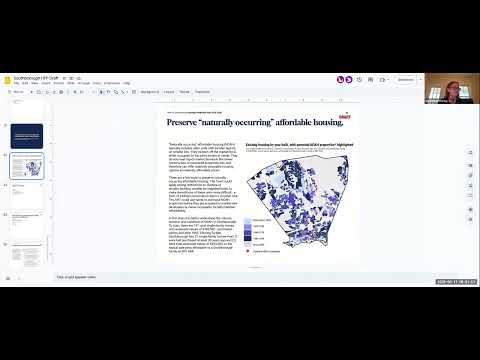
Sarah Brent described an analysis using assessed value, sale dates and building dates to identify likely NOAH. She reported “there are a 191 total single family homes” at or below an assessed value threshold aligned with affordability near 80% area median income, and noted only “31 were last purchased at least 30 years ago and have that assessed value,” language Brent said required cleanup in the draft. Committee members flagged that assessed value is an imperfect proxy and asked staff to verify counts.
Members debated approaches. Some favored targeted acquisitions by the housing trust; others raised property-rights concerns about preservation overlays. One member said acquisitions can be effective but cautioned limited Trust funds: “We do this twice, and then that's all of our funds.” The group discussed incentives and tax-relief mechanisms as alternative tools and suggested research into models other towns use to preserve NOAH without broadly restricting property rights.
On capacity, members discussed hiring a part-time staff person to support the Trust’s work. Brent and committee members noted prior use of state grant funds to fund part-time staff in other communities and described a part-time coordinator as important for tracking zoning outcomes, managing partnerships (for example, with Habitat for Humanity), and pursuing state grant programs.
The committee also discussed pursuing Housing Choice designation to gain access to state technical assistance and grant preferences for infrastructure projects tied to housing production. Leah Emerson, the town’s economic development coordinator referenced in the discussion, was cited as a staff contact for that work.
No formal vote was taken on preservation overlays, acquisitions, or staff hiring; the committee directed Brent and staff to research examples and prepare options for a future meeting.