Get Full Government Meeting Transcripts, Videos, & Alerts Forever!
Get email alerts on the Housing Production Tools topic
No spam. Unsubscribe anytime.
MBTA overlay, ADUs and Route 9 development highlighted as primary production levers in Southborough plan
Summary
Committee members flagged the MBTA Communities overlay, ADU legalization, and Route 9 development (tied to wastewater capacity) as principal tools to meet production goals; members asked staff to document 40B pipeline status and ADU permit history.
Committee members focused on production strategies that could deliver measurable housing units over the next five years, naming three primary levers: the MBTA Communities overlay districts, accessory dwelling units (ADUs) enabled by recent state law, and targeted redevelopment along Route 9.
Sarah Brent told the committee the MBTA overlay districts have an estimated total capacity of 828 units, which “if you subtract all the existing units, it's closer to about 650 net new units” at full buildout. She said the MBTA overlay’s inclusionary provisions will affect how many of those units will be income-restricted, and she plans to estimate net new affordable units after receiving the compliance calculator from town staff.
On ADUs, Brent said Southborough could expect “3 to 4 ADUs per year or about 15 to 20 over the housing production plan timeline” if permitting and construction patterns follow other communities that legalized ADUs by right. Committee members asked staff to confirm recent ADU permit counts with building department staff; Lara Davis and Corinne were named as contacts to provide data.
Members also discussed vacant and underutilized parcels along Route 9 as priority locations for scaled development. Brent reported she mapped parcels within 500 feet of Route 9 that have higher land value than structure value and are not conservation land; she found many were nonresidential uses and that “23 of those…are currently listed as a vacant use.” The committee emphasized the town’s wastewater capacity as a constraining factor: members asked that the plan explicitly link Route 9 production potential to “the need to add wastewater capacity along Route 9.”
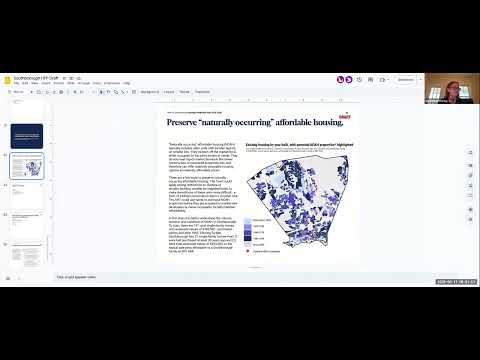
Committee members asked Brent to highlight active Chapter 40B proposals near Route 9 on maps and to footnote their status “as of June 2025.” The group agreed to show the downtown zoning map and indicate where MBTA overlay districts and other flexible provisions apply.
No zoning change was voted on; the discussion produced direction to collect data (ADU history, 40B status, zoning maps) and to illustrate production capacity and constraints in the next draft.