Get Full Government Meeting Transcripts, Videos, & Alerts Forever!
Get email alerts on the Code Enforcement topic
No spam. Unsubscribe anytime.
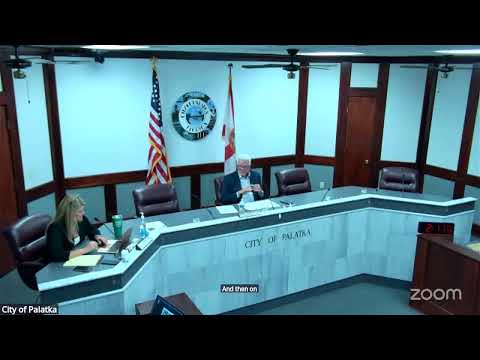
Palatka hearing finds shed lacks required building permit; owner ordered to start permits within 30 days
Summary
At a June 17 Palatka code-enforcement hearing, the hearing officer found a shed at 507 Dunham Street was installed without the required building permit and ordered the owner to begin county and city permit applications within 30 days or face a $250-per-day fine.
A hearing officer in Palatka found June 17 that a storage shed on property at 507 Dunham Street was installed without the required building permit and ordered the property owner to begin the county and city permitting process within 30 days to avoid fines.
The finding came at a code-enforcement hearing presided over by attorney Ron Brown, who said the city alleges violations of city code sections 94-33 (building permits for accessory structures) and 94-192 (restrictions on parking, storage or use of certain recreational equipment). Brown told the owner that if he did not “get it started within the next 30 days, you’re gonna get a $250 a day fine.”
The case, listed as 202526, involves owner Kyle Grimes. Christy Locksley, a code-enforcement officer who presented the case for the city, said the violation was first observed on March 7, 2025, and that the hearing notice was mailed on June 3, 2025. Locksley also confirmed that the property was posted and certified-mail return receipts were received.
City staff and code-enforcement officers told the hearing that two compliance issues were at stake. The first, under Section 94-33, is that the shed is an accessory structure that requires a building permit; the record shows the county issues building permits for structures above certain sizes and the city verifies zoning and setbacks under an interlocal arrangement. Staff explained that the county typically issues building permits for accessory structures over roughly 150 square feet, and the city’s approval of the accessory structure depends on the county application and zoning verification.
The second allegation, under Section 94-192, raised whether the shed or the items stored there constituted “major recreational equipment” or was being used for living, sleeping or housekeeping. Evidence and neighbor testimony were conflicting on whether anyone was living in the structure. A neighbor who identified himself as Matt testified under oath that the person associated with the shed had been staying nearby and had not lived in the shed. The hearing officer said the record contained conflicting information and declined to find a violation of Section 94-192 at this time, calling it “a close call.”
Grimes acknowledged mistakes in the permitting process and said he had paid fees; he told the hearing, “I did make a mistake … the permit is usually $50. I had to pay a $100, and I did that.” City staff described confusion in the permitting timeline, noting deed/ownership changes and delays in filing that contributed to the dispute.
The hearing officer’s order requires Grimes to start the county building-permit application and the city zoning/permit coordination within 30 days of the hearing. Brown said the practical deadline is July 17, 2025, and that if the permitting process is not started or does not show adequate progress, the city may impose a $250-a-day administrative fine beginning July 18. Brown cautioned that if evidence later shows someone is living in the shed, the city would take a stricter view.
Staff asked Grimes to provide documentation related to a lease and to coordinate directly with code-enforcement staff and Harold Bartoli (the officer managing follow-up) to verify progress. The hearing record notes that the shed was first observed on March 7 and that notices were mailed and posted on June 3; the owner said he travels frequently and has been staying with neighbors while resolving matters.
The hearing officer emphasized that the city’s goal is compliance rather than collection of fines if the owner makes timely progress on permits. The matter will return for review after the 30-day period if the city determines insufficient progress has been made.