Senate committee presses Energy Secretary on budget effects for grid reliability, national labs and DOE loan projects
Loading...
Summary
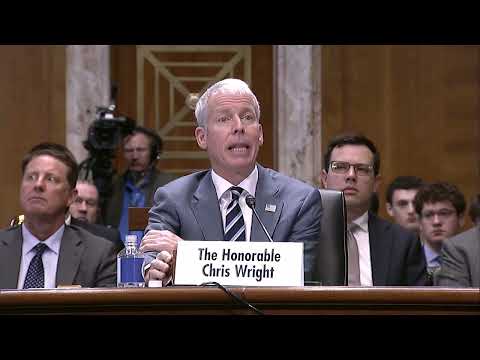
A senator on the Senate Energy and Natural Resources Committee pressed the U.S. Secretary of Energy on whether the president’s proposed budget and recent DOE procedural changes would harm grid reliability, reduce national-lab capacity and slow projects in the Department of Energy’s loan pipeline.
The exchange centered on DOE modeling of supply and cost, a proposed $2,750,000,000 reduction the senator said was in the president’s budget for national laboratories, delays in loan-program projects in New Mexico and the role of political appointees on DOE review boards.
The senator asked whether DOE had done modeling to “determine the specific impacts of this proposed budget on both supply, energy supply, and cost.” The secretary replied that DOE “has a team, in fact, that develops a model of the grid that looks at the grid by regions,” and cited a recent DOE order to keep a coal plant in southwestern Michigan open because of small reserve margins on the MISO grid.
On laboratory funding, the senator said engineers at Sandia National Laboratories had told him the cut would “significantly affect the Center for Integrated and Nanotechnologies, national user facilities, research equipment, … limit fusion research on reactor environments and advanced materials, and jeopardize environmental monitoring,” possibly exposing DOE to penalties under a “consent agreement with the New Mexico environment department.” The secretary said allocations to individual labs had not yet been made and emphasized his goal “is to grow, not shrink, the output of top quality science at our labs.”
The senator also raised stalled projects in DOE’s loan program office, saying two New Mexico projects — geothermal and a grid-reliability project — “have both been in the loan program office pipeline for a very long time” and that recent back-and-forth communications had “gone away.” The secretary committed to reengage, saying, “Yes. Yes. Indeed, sir,” and earlier told the senator, “You bet. You’ll get a response,” in response to a request to reply to letters sent to his office.
The hearing included a dispute over retail electricity price figures. The secretary stated, “Yeah. It’s about 14¢,” when asked the rough national average retail price per kilowatt-hour. The senator said he believed the figure was “17. 17.1 right now” and later corrected his own earlier statement about his retail price to say it was “10.8” cents per kilowatt-hour for his utility, provided along with capacity percentages he attributed to his utility (35% solar, 15% wind, 15% battery storage, 5% coal, 23% gas) and clarified those were capacity numbers.
The senator also described industry comments he had cited — for example, that NextEra’s CEO had noted increases in the cost per kilowatt to build gas-fired capacity and that retiring coal plants alone would provide only limited new capacity — and asked whether DOE had included such factors in its modeling. The secretary described DOE’s engagement with grid operators and utilities when making decisions and pointed to a prior DOE action to keep a Michigan coal plant online because of reserve concerns.
The secretary and the senator disagreed over whether review boards in DOE’s loan program include political appointees. The senator said his staff had been briefed that political appointees served on review boards; the secretary confirmed they do, describing review boards as a “hybrid” that include political appointees who evaluate financial statements and play a business role. The senator asked why political appointees were used in earlier stages rather than only for final sign-off; the secretary said the current process was “vastly more professional and vastly less political than it was in the previous administration.”
No formal committee action or vote occurred in the provided transcript excerpt. The secretary said the budget decisions would be made at a later allocation stage and repeatedly characterized some changes as responses to fiscal constraints.
What’s next: the senator requested a written response to letters sent to the secretary’s office and asked DOE to reengage its loan program office on the two New Mexico projects; the secretary pledged both a written response and reengagement. The committee discussion identified multiple follow-ups the senator said he would pursue, including asking for modeling and lab-by-lab impact analyses if allocations are proposed.