Get Full Government Meeting Transcripts, Videos, & Alerts Forever!
Get email alerts on the City Budget topic
No spam. Unsubscribe anytime.
Superior officials present balanced 2014 budget but warn of bigger 2015 shortfall
Summary
Finance Director Jean Vito told the Common Council the city received a clean audit and the preliminary 2014 general fund budget is balanced, but ongoing state levy limits, flat shared revenue and the pending end of a SAFER grant could produce a projected $1.3 million deficit in 2015 unless addressed.
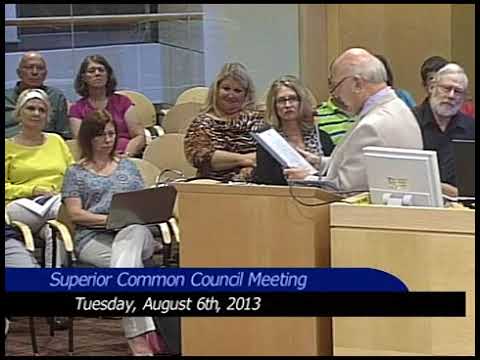
Finance Director Jean Vito told the City of Superior Common Council that the city received an unqualified, or “clean,” audit and that the preliminary 2014 general fund budget presented to the council is balanced, but that projected deficits in 2015 will require action to avoid service cuts.
The clean audit was presented as part of the council’s consent agenda and accepted by the council. “I’d call it a clean audit,” Vito said during the meeting as she summarized the auditors’ findings and follow-up steps.
Vito and Mayor Bruce C. Hagen told the council the budget outlook is constrained by state levy limits and flat or reduced shared revenue. Vito said the city has cut staffing about 10 percent since the 2008 recession and that long-term revenue shortfalls have compressed options for restoring services. She said the 2014 timeline calls for formal budget sessions beginning Aug. 20, with a public hearing planned for the second meeting in October and the tax roll filed with Douglas County in early December.
Nut graf: The administration presented a 2014 plan the city can balance this year in part because of one-time and timing items, including about $800,000 in remaining bond proceeds from Tax Increment District No. 9 that staff proposes moving into the capital improvement program. But staff warned those one-time moves and the pending end of a federal SAFER grant that funds firefighter positions could leave the city facing roughly $1.3 million in recurring shortfalls in 2015 unless the council takes additional steps.
Most important facts: Vito said the city’s net assets increased by just over $4 million in 2012 and that an $800,000 TID bond-proceeds balance could be used to reduce the general fund transfer into capital projects in 2014. She said the budget packet presented to councilors will include six months of current-year actuals, line-by-line division budgets and capital and grant details ahead of the Aug. 20 session. Vito said the current 2014 budget includes a contingency of about $116,000.
Councilors and staff flagged several fiscal risks. Vito and other staff noted: - State levy limits and cuts to shared revenue have kept major revenue sources flat for years, limiting the city’s ability to raise operating revenue without a referendum. - The SAFER (Staffing for Adequate Fire and Emergency Response) grant funds six positions; the grant’s scheduled end (staff noted an overlap into 2015 is possible) will increase recurring costs. - The city’s sewer/wastewater fund had required a one-time transfer in a prior year; a transfer back to the general fund of about $508,000 helped 2012 results but similar one-time fixes will not be repeatable. - Long-term liabilities such as other post-employment benefits (OPEB) are tracked by actuarial studies; staff said prefunding exists but is not held in an irrevocable trust so the accounting rules treat it as accessible for other uses.
Councilor Bender moved to return a separate Human Resources Committee item (item 6.3) to committee for further review after raising concerns that a position had been advertised and filled before council approval; the motion passed. That personnel item and other staffing questions were discussed in the audit briefing and tied into the broader budget conversation about whether positions are needed and how wage and personnel changes might affect 2014 expenditures.
The council also approved an ordinance amendment to explicitly return the city to a one-year budget cycle, changing language in the city code so budget references read “one-year budget.” The change was proposed and approved as an amendment during the ordinance discussion.
Vito and other staff described options the council may consider in 2014 to address the projected 2015 shortfall, including using one-time reserves or TID proceeds for limited, planned purposes, adjusting transfers to capital, or identifying further operational reductions. Mayor Bruce C. Hagen cautioned that using reserves to cover recurring operating costs would be risky long-term and noted two local structural anomalies that make Superior’s position unusual in Wisconsin: the city does not assess special assessments for sidewalk/curb/gutter/sewer/street projects (those costs sit in general funds) and the city operates a municipal landfill (an operation fewer municipalities directly manage), both of which affect budgeting choices.
Staff outlined next steps: detailed budget packets will be distributed to councilors a week before the Aug. 20 budget session; three council budget sessions are scheduled as placeholders (Aug. 20, Sept. 3 and Sept. 17) and more can be added; the public hearing is planned for the second meeting in October; and the tax roll must be submitted to Douglas County in early December.
Ending: Councilors asked staff for benchmarking and reserve-level detail at the Aug. 20 session. Vito said she would provide reserve-level recommendations and comparable community data for that meeting so the council can weigh one-time fixes against sustainable long-term choices.