Get Full Government Meeting Transcripts, Videos, & Alerts Forever!
Get email alerts on the Tax Increment Financing topic
No spam. Unsubscribe anytime.
Council declares TID 11 distressed, allows TID 7 to share excess revenues
Summary
The Superior City Council voted to declare Tax Increment District (TID) 11 distressed and approved an amendment to allow TID 7 to share excess revenues with TID 11 to cover prior acquisition costs and reduce pressure on city funds.
The Superior City Council voted to declare Tax Increment District 11 distressed and to amend the project plan for Tax Increment District 7 to allow TID 7 to share excess revenues with TID 11, the council decided after a presentation and a public hearing with no speakers.
Sean Lentz, with Eller's and Associates, told the council the city seeks to declare District 11 distressed under recent Wisconsin state law changes that allow relief for struggling tax increment districts. He said the designation is intended to address cash‑flow problems and the district’s inability to recoup prior expenses.
The action matters because the city has incurred roughly $3.1 million in principal and interest related to property acquisition and demolition in TID 11. Lentz said the district has produced no increment value and currently shows a negative taxable value because the city removed properties from the tax rolls to prepare the site for redevelopment. He said the distressed designation would permit the city to extend the district’s expenditure period by up to 10 years and make District 11 eligible to receive excess increment from another city district, most likely District 7.
Councilors asked how the revenue sharing would work and what limits apply. Lentz said District 7 must first cover its own annual costs; only surplus revenues would be available to transfer. He presented a forecast showing District 7 currently collecting roughly $200,000 a year in increment while its debt service is under $100,000, creating capacity for contributions. He also said the projection assumes District 11 never generates increment; if it does, sharing would end sooner.
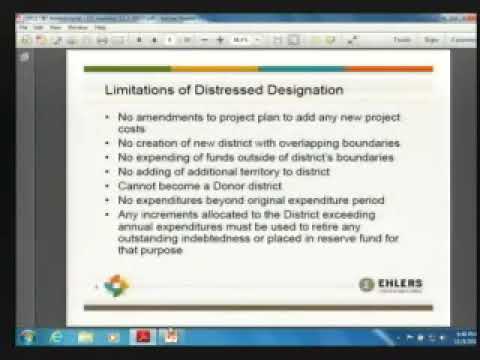
Lentz described statutory and practical limits tied to the distressed designation: the city could not amend District 11 to add new project costs, District 11 could not serve as a donor district, and any revenues over existing project costs would be placed in a reserve fund to repay expenditures. Councilors also asked whether the distressed designation could later be reversed; Lentz said the law currently provides no mechanism to “undistress” a district without legislative change.
Councilors raised contingency questions: if District 7’s revenues decline, Lentz said the city could consider other donor districts or return to general city funds to cover shortfalls. He also noted the process requires review by a Joint Review Board and had been reviewed by the plan commission earlier in the day.
The council held a combined public hearing for three resolutions (designating TID 11 distressed; approving an amendment to TID 11’s project plan; approving an amendment to TID 7’s project plan to permit sharing). With no public comments, a motion to approve the three resolutions passed on a voice vote. The clerk read the three resolutions for consideration; the council voted in favor with the result recorded as “motion carried.”
The council’s action is intended to remove the need for the city to advance funds from other city accounts to cover TID 11 shortfalls and to use excess increment in District 7 to repay the $3.1 million in acquisition and related costs, subject to the limits Lentz described.
Councilors and staff noted remaining constraints on future redevelopment options for District 11; because of the distressed designation the city would lose certain tools (for example, the ability to amend the district to add parcels or new project costs) that could limit incentives should District 11 later produce substantial increment.