Get Full Government Meeting Transcripts, Videos, & Alerts Forever!
Get email alerts on the Sewer Utilities topic
No spam. Unsubscribe anytime.
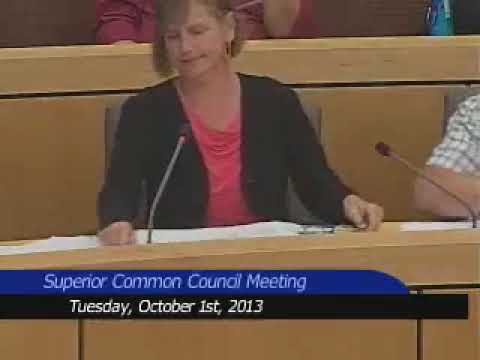
Superior council approves modest sewer‑usage increase to fund plant and infrastructure work
Summary
By a 6–3 vote the council approved an ordinance to raise the variable sewer charge from $7.43 to $7.71 per 100 cubic feet effective January 2014, citing replacement of aging pumps, ultraviolet disinfection tie‑in, HVAC and drainage improvements and inflationary adjustments.
The Superior Common Council approved an ordinance increasing the variable sewer charge from $7.43 to $7.71 per 100 cubic feet of usage, effective Jan. 1, 2014, to finance a set of wastewater treatment plant and drainage projects council staff said are needed to maintain permit compliance and reduce sanitary sewer overflows.
Environmental Services Director Steven Roberts told council members the increase is intended to pay for a package of projects: replacement and reconfiguration of plant pumps that were installed in 1958; a direct flow connection from final clarifiers to the facility’s ultraviolet disinfection system; HVAC improvements in the office building; localized combined‑sewer drainage upgrades; and an inflationary adjustment. Roberts said the current request is a smaller increase than several prior recent adjustments because of prior project cost savings and higher than projected water usage that produced a temporary credit.
Roberts provided a multi‑year forecast: staff’s current projection shows an additional roughly $0.50 per 100 cubic feet increase in 2015 and about $0.35 in 2016 as later projects go forward. He gave a household‑level example: a single‑person household would pay about $0.56 per month more under the 2014 increase; an average residential household (based on 2012 usage) would see about $1.29 per month.
Opponents called out the effect on residents with fixed or low incomes. “I just can’t support this ordinance at this time, not with the economy the way it is,” Councilor Galbick said during debate. Multiple councilors said they understand the burden but argued phasing work and rates is preferable to deferring projects that would create permit or public‑health risks.
At roll call several councilors recorded their votes during the final tally: Councilor McKenzie recorded “No,” Councilor Dalbeck recorded “No,” Councilor Olsen recorded “Yes,” Councilor Fennessy recorded “Yes,” Councilor Bender recorded “No,” Councilor McDonald recorded “Yes,” Councilor Missoulia recorded “Yes,” and Councilor Finsland recorded “Yes.” The motion passed 6–3.
Roberts told the council that failing to move forward on the work would risk sliding the permit compliance schedule and could expose the city to enforcement or consent‑decree risk if sanitary sewer overflows are not addressed on schedule. Several councilors urged phased implementation to reduce immediate household impacts while addressing aging infrastructure.
The council adopted the ordinance as presented; the change amends Chapter 114, Article 2 (sewer usage) and raises the variable charge to $7.71 per 100 cubic feet effective Jan. 2014.