Get Full Government Meeting Transcripts, Videos, & Alerts Forever!
Get email alerts on the Preschool Funding And Local Tax topic
No spam. Unsubscribe anytime.
State economists and child‑care officials brief Senate on Multnomah County preschool tax, program overlap and economic indicators
Summary
An informational meeting examined Multnomah County’s Preschool for All tax and how it overlaps with state-funded preschool programs; the state economist also presented data showing rising unemployment and sectoral job losses in Oregon.
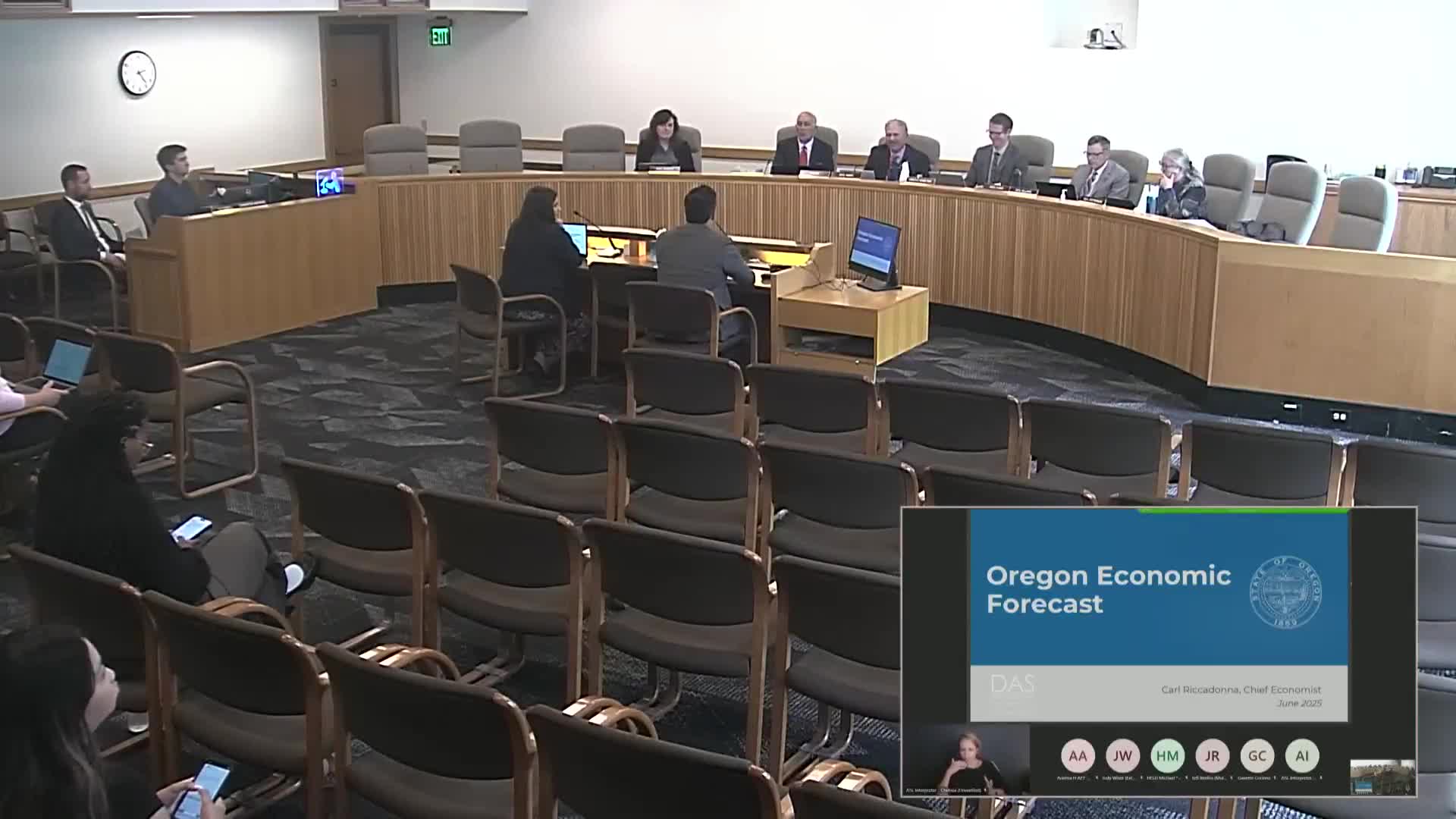
The Senate Committee on Finance and Revenue held an informational meeting on the impact of local income taxes on state and local revenue, focusing on Multnomah County’s Preschool for All tax, state preschool programs and the broader economic context.
State Economist Carl Riccadonna opened with an economic update, noting Oregon’s May unemployment rate at 4.8%, up from 4.1% a year earlier, and net payroll declines of about 1,400 jobs for the month. Riccadonna highlighted weakness in construction and manufacturing and flagged demographic trends—lower population growth and an aging profile—that could dampen future revenue growth.
Alyssa Chatterjee, Early Learning System Director for the Oregon Department of Early Learning and Care, described state-administered preschool programs and how they interact with local initiatives. She summarized three core state programs: Preschool Promise (state-funded slots for families up to 200% of federal poverty level), OPK (Oregon Prenatal to Kindergarten, the state Head Start model, generally for families at or below 100% of federal poverty level and certain categorical eligibilities), and ERDC (a childcare subsidy voucher up to 250% of federal poverty level).
Multnomah County economist Jeff Renfro explained the county’s Preschool for All tax structure and how a planned 0.8 percentage‑point increase applies: the 1.5% rate on taxable income above $200,000 would rise to 2.3%, and the 3% rate on income above $400,000 would rise to 3.8%. Renfro said Multnomah’s approach is designed to supplement state programs rather than supplant them. He also said the county is tracking tax‑return data closely and has convened a technical advisory group to study longer‑term impacts.
Program scale and funding: Alyssa Chatterjee provided slot counts for Multnomah County from state materials: 1,241 state‑funded OPK preschool slots and 616 federally funded Head Start slots across 47 sites; 587 Preschool Promise slots provided to 24 providers at 34 sites in the county. Renfro told the committee that the county’s program carried a fund balance (saved early surpluses) of approximately $480 million intended to be spent down as the program scales.
Policy questions and concerns: Senators asked whether state slots preclude county-funded slots and how eligibility and enrollment are coordinated. Chatterjee said state and county programs are administered separately but local coordination varies; grant terms prevent supplanting, so families typically are not enrolled simultaneously in overlapping state and county funded slots (though families may supplement with ERDC for additional hours). Senators also raised questions about program audits and program performance; the committee referenced a recent Multnomah County Auditor review and public reporting.
Action and outcome: This was an informational hearing; no bill votes were taken on preschool policy during the session meeting. Committee members asked staff and the county for follow-up data; Multnomah County said it will continue providing tax‑return analytics and the county will hold public hearings and convene a technical advisory group and an early‑childhood work group to study program design and tax impacts.
Next steps: The county plans additional public meetings in July and August and the county technical advisory group will study tax impacts and program changes. The Legislature’s oversight may continue as policy and budget discussions proceed.