Get Full Government Meeting Transcripts, Videos, & Alerts Forever!
Get email alerts on the Wildfire Funding topic
No spam. Unsubscribe anytime.
Committee Hears Testimony on HB 3,940 A; Amendment Would Fund Wildfire Mitigation With Oral-nicotine Tax and Rainy Day Interest
Summary
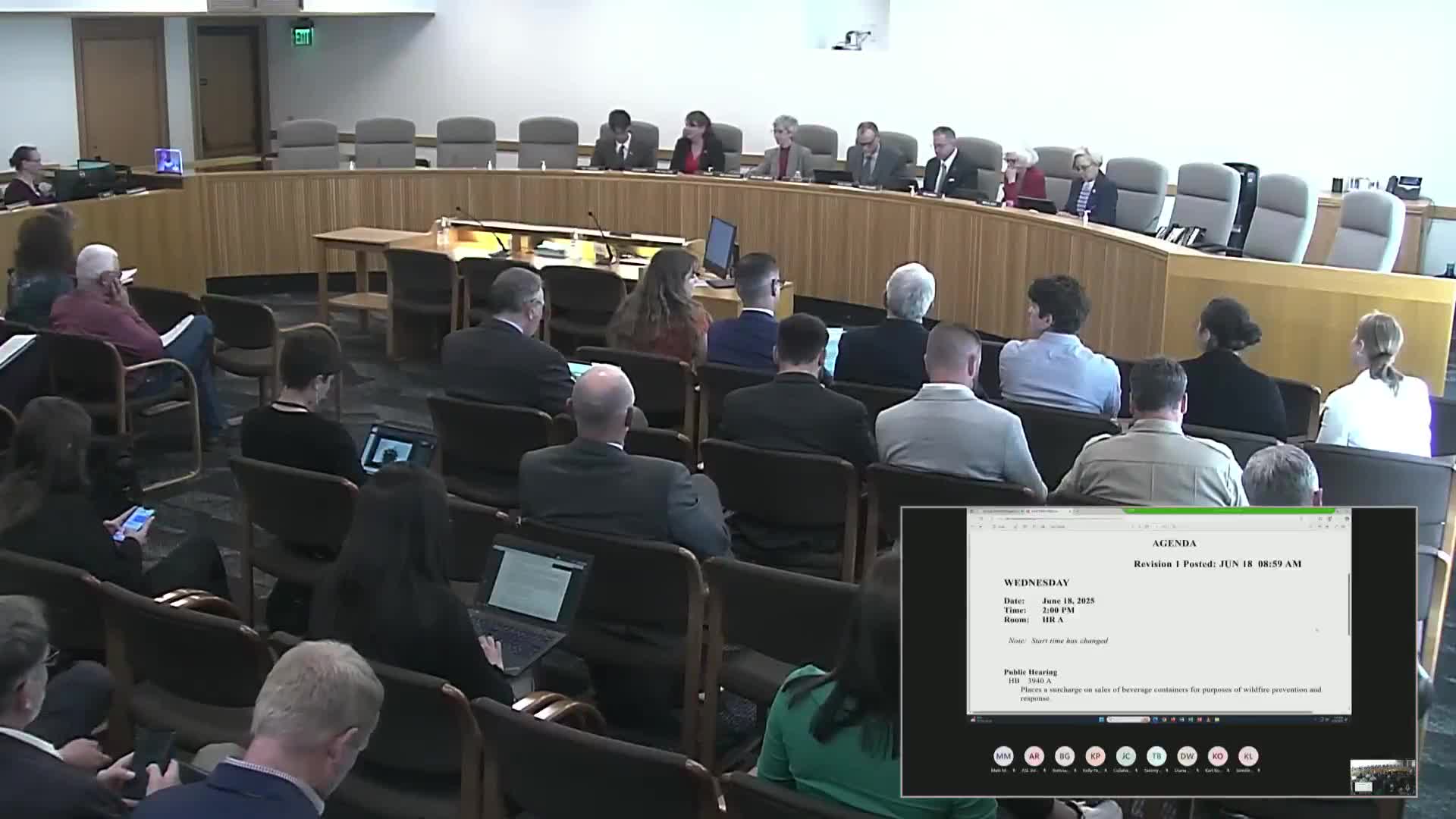
House Committee on Revenue Chair Nathanson opened a public hearing June 18 on House Bill 3,940 A, which would fund wildfire mitigation and community risk reduction through a new oral‑nicotine tax and a portion of rainy‑day fund interest.
House Committee on Revenue Chair Nathanson opened a public hearing June 18 on House Bill 3,940 A, a package of changes to Oregon's wildfire funding framework that lawmakers and stakeholders said is urgently needed as the state faces an early and active fire season.
The dash‑a21 amendment before the committee would add two new revenue streams to pay for wildfire mitigation: a new state tax on oral nicotine products (65¢ per container of up to 20 consumable units and 3.25¢ per unit for containers with more than 20 units) and a transfer of 20% of projected interest earnings from the state rainy‑day fund for the coming biennium, split roughly 6.7% to the landscape resiliency fund and 13.3% to the community risk reduction fund. The amendment also redirects other existing assessments and changes private‑landowner assessment formulas included in the underlying bill.
Why it matters: Supporters said the state must secure predictable, durable revenue to fund mitigation and readiness programs that reduce risk to homes, businesses and public health. "This couldn't be more urgent and more of an acute need," said Senator Anthony Broadman, state senator for Central Oregon, who described the proposal as "the planned Wildfire Investment and Safety Enhancement Fund" and said it pairs mitigation priorities with new revenue. Several witnesses recommended a larger transfer of rainy‑day fund interest than the amendment provides; multiple speakers asked the committee to consider using 100% of rainy‑day interest rather than the 20% in the dash‑a21 drafting.
Testimony in support: Several fire‑service leaders, forest industry representatives, county officials, conservation groups and small woodland owners testified in favor of HB 3,940 A or the dash‑a21 drafting as a start toward a durable funding approach. Carl Kennig, president of the Oregon State Firefighters Council, and Ben Stang, fire chief of Polk County Fire District No. 1, urged funding for mitigation, readiness and large‑fire response. The Oregon Forest Industries Council's president Chris Edwards and Green Diamond Resource Company representative Jason Callahan described private‑landowner rate pressures and urged additional rainy‑day interest be dedicated to wildfire response.
Workforce and youth programs: Senators and witnesses pressed to preserve or expand funding for the Oregon Conservation Corps (OCC) and similar youth workforce programs. Senator Jeff Golden asked the committee to consider the dash‑a22 amendment, which would dedicate an additional 7% of rainy‑day fund interest to sustain OCC funding (the 7% figure was chosen to approximate $10 million in current funding), and representatives of Northwest Youth Corps and regional councils described OCC and related crews as a low‑cost source of fuels‑reduction labor and workforce training.
Public health and tobacco‑tax concerns: Some public health witnesses opposed using an oral‑nicotine tax solely to fund wildfire programs. Senator Lisa Reynolds, who also identified herself as a pediatrician, said she opposes including an oral‑nicotine tax in the amendment because tobacco‑tax revenues have historically been directed to cessation and public‑health programs. Heidi Lowe of the Campaign for Tobacco‑Free Kids and Sarah Lochner of the Coalition of Local Health Officials urged a much higher per‑container tax (they recommended rates equal to the cigarette tax) and suggested part of any new revenue be directed to local public‑health programs because wildfire smoke and tobacco use together increase respiratory harms.
Technical and legal questions: Committee members questioned whether the amendment's language would allow local governments to impose additional taxes on oral‑nicotine products. Kate Tosswell, chief deputy legislative counsel, explained the draft adds a new tax provision adjacent to Oregon Revised Statutes chapter 323's other‑tobacco provisions; she said that—because oral‑nicotine products in the amendment are defined as non‑inhaled ‘‘oral nicotine products’’—the provision would be a novel, state‑level tax on those products and that current statutory preemptions on local tobacco taxes do not specifically address these non‑inhaled oral products. Tosswell cautioned that the chapter's drafting history and related definitions shape enforcement and preemption outcomes.
Revenue and program numbers referenced: Witnesses referenced several fiscal figures during testimony. The Legislative Revenue Office estimate cited in public testimony projected roughly $10 million in new revenue for the upcoming biennium from the proposed oral‑nicotine tax. Senator Golden and others discussed dedicating additional portions of rainy‑day fund interest to reach existing program funding levels; one commonly cited target was $150 million for large‑fire suppression included in the governor's recommended budget. Witnesses also noted that sustaining OCC at current levels would require about $10 million annually.
No committee action recorded: The June 18 hearing consisted of testimony and questions; the transcript records no committee vote or formal action. Committee members asked questions of legislative counsel and witnesses; several members signaled support for advancing the bill with refinement of rainy‑day allocations, but no motion or vote appears in the hearing record.
What’s next: The public hearing closed at the scheduled time; committee staff and legislators indicated the bill and posted amendments would be considered in subsequent work sessions. Multiple witnesses urged prompt legislative action to secure mitigation, readiness, and workforce funding ahead of a fire season they described as already active.