Get Full Government Meeting Transcripts, Videos, & Alerts Forever!
Get email alerts on the Recreational Liability topic
No spam. Unsubscribe anytime.
Senate committee advances SB 1196 to strengthen enforceability of recreational liability waivers
Summary
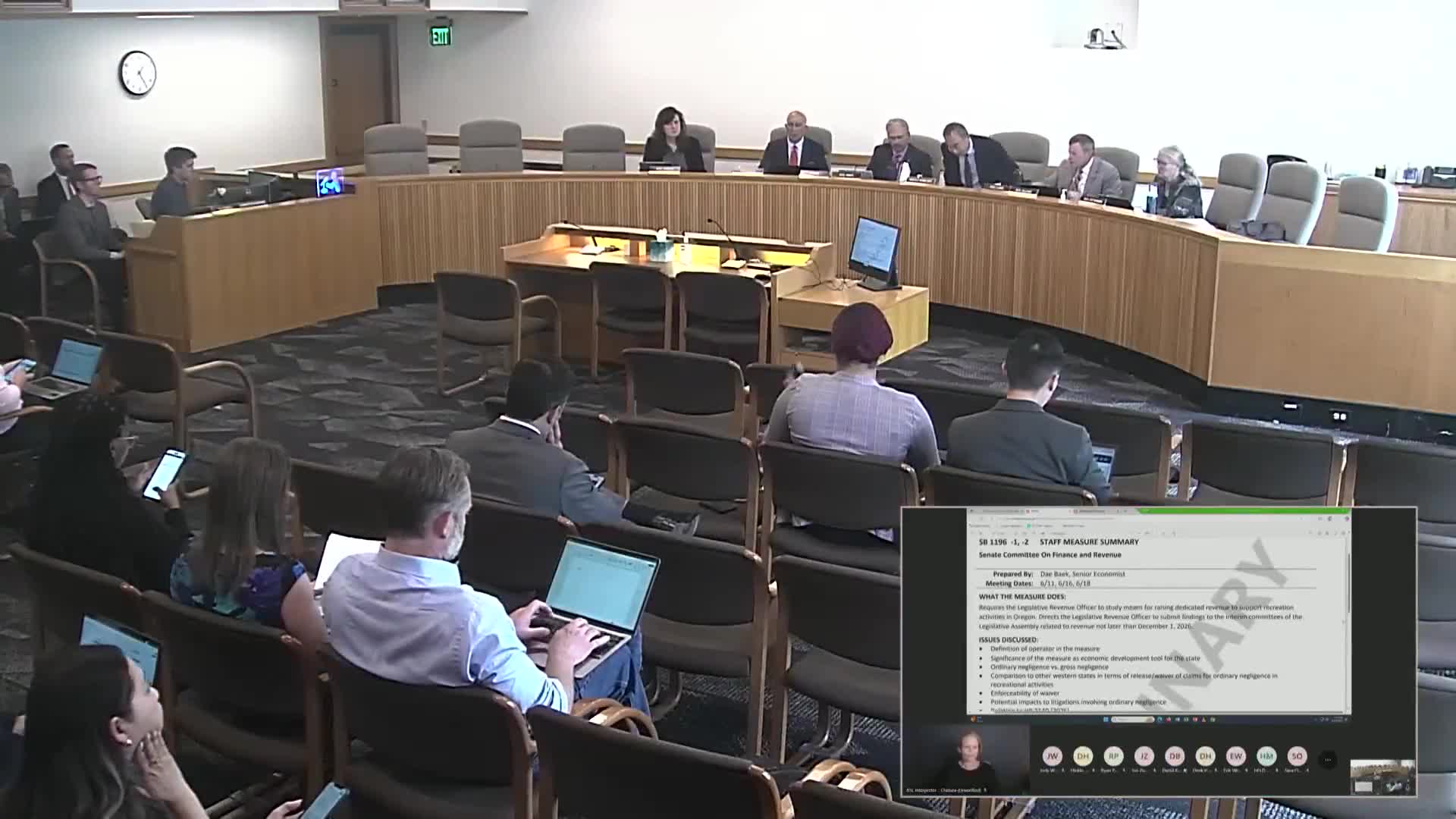
After hours of testimony from outfitters, insurers and trial lawyers, the Senate Finance and Revenue Committee adopted a Dash‑2 amendment to SB 1196 and voted to send the bill as amended to the Senate floor with a due-pass recommendation.
The Senate Finance and Revenue Committee on June 18 heard extended testimony on Senate Bill 1196, a proposal to make liability waivers and the inherent‑risk doctrine more enforceable for recreation providers. After public testimony that split sharply between outfitters and insurer representatives on one side and trial lawyers and consumer advocates on the other, the committee adopted the dash‑2 amendment and voted to send the bill to the Senate floor with a due‑pass recommendation.
Proponents — owners of guiding companies, county search-and-rescue volunteers and representatives of the ski and resort insurance market — told the committee the current liability climate has made insurance unaffordable or unavailable for many recreation providers. Zeke Heitkamp, owner and co-founder of Next Adventure, described the company’s decision to close: “We are going to be sued and we are going to lose. And we are going to exit the industry,” he said, arguing the absence of enforceable waivers has cut access to insurance for outfitters.
Insurance and resort-industry witnesses described sharply higher loss experience in Oregon. Ryan Patrick, senior vice president and general manager at Safehold Special Risks, said Oregon’s excess loss ratio in his program is “about 20 times higher than all other states,” and that excess loss dollars from Oregon represent nearly half of the program’s nationwide payouts. He told the committee his program has been forced to stop offering coverage in Oregon until legal protections change.
Opponents cautioned that similar tort-reform measures elsewhere have not reliably reduced premiums and warned that removing liability for negligence would harm injured Oregonians. Daniel Henkel, senior counsel for policy and state affairs at the American Association for Justice, said, “Evidence shows insurers will simply pocket the costs that they would have otherwise had to insure,” and argued decades of data do not show reduced liability leads to cheaper premiums for consumers.
Action taken: Vice Chair McLean moved adoption of the dash‑2 amendment. The amendment was adopted on roll call (Yes: Senator Starr, Vice Chair McLean, Chair Meek; No: Senator Patterson, Senator Taylor). Vice Chair McLean then moved the bill, as amended, to the Senate floor with a due‑pass recommendation. The committee recorded the final work session vote as: Senator Patterson — No; Senator Starr — Aye; Senator Taylor — No; Vice Chair McLean — Aye; Chair Meek — Aye. The motion passed and Chair Meek agreed to carry the bill to the full Senate.
Discussion versus decision: The committee’s votes forward SB 1196 as amended; those votes were procedural steps to send the bill to the Senate floor. The hearing record preserves substantive disagreements: proponents said the bill protects small businesses, preserves public access to recreation, and prevents insurer withdrawal; opponents said the bill reduces accountability for negligence and is unlikely to lower market premiums.
Context and next steps: Testimony repeatedly cited the 2014 Bagley Supreme Court decision and a 2022 mountain-bike verdict as background for changing liability practice in Oregon. Supporters compared Oregon to other Western states that allow waivers; opponents disputed the comparisons and said Oregon’s negligence standard and other legal details differ. The bill will be considered next by the full Senate; any final legal standard or statutory language will be established in subsequent floor debate and potential amendments.