Get Full Government Meeting Transcripts, Videos, & Alerts Forever!
Get email alerts on the Property Tax Reform topic
No spam. Unsubscribe anytime.
Senate committee orders Legislative Revenue Office study of Oregon property tax system under HB 2321A
Summary
The Senate Committee on Finance and Revenue advanced House Bill 2321A, which directs the Legislative Revenue Office to report by Dec. 2026 on Oregon's property tax system, including effects of Measures 5 and 50 and local government concerns.
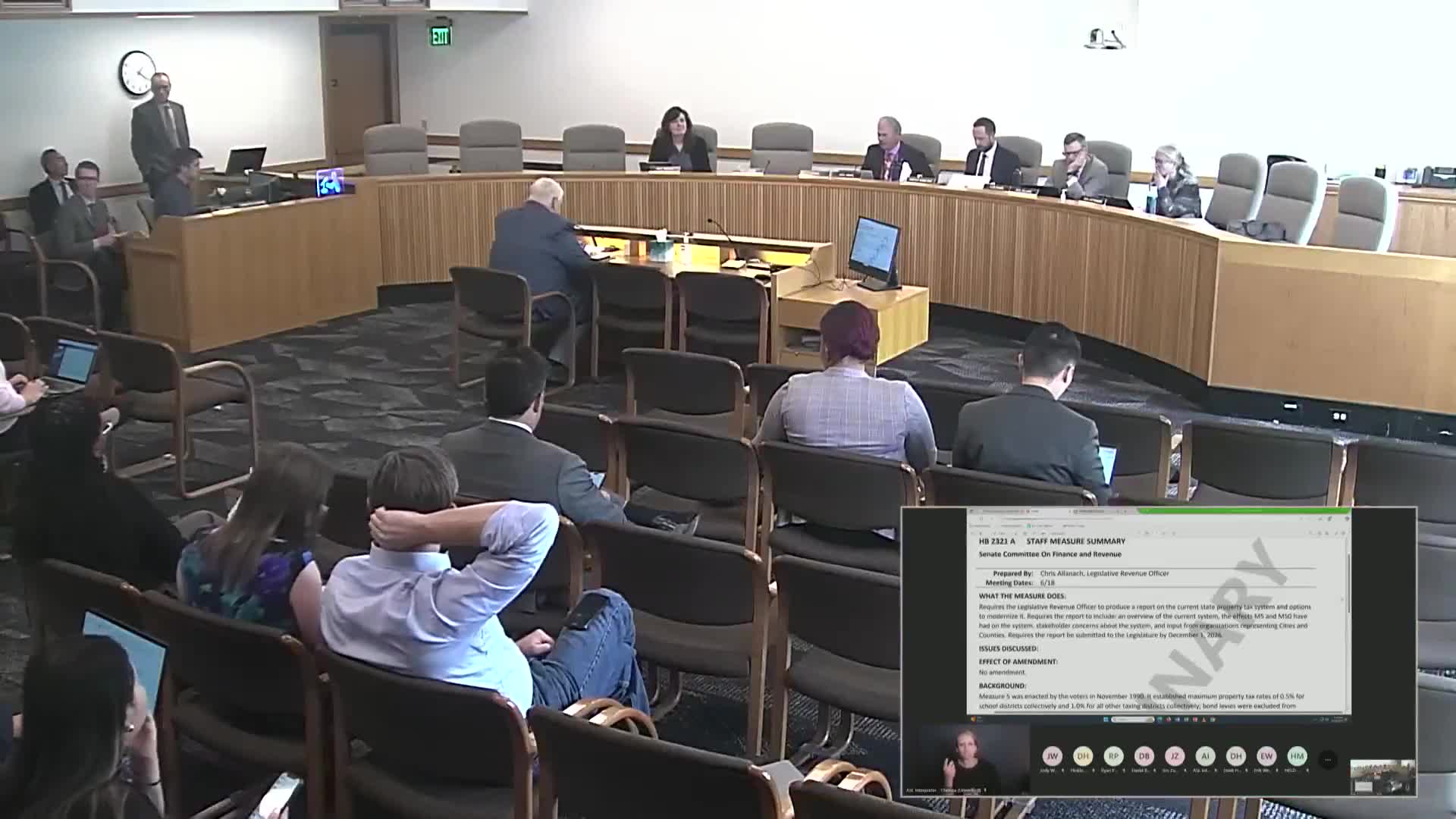
HB 2321A, which asks the Legislative Revenue Office to produce an in-depth report on Oregon’s property tax system, was the subject of an informational hearing and was moved to the Senate floor with a “do pass” recommendation.
The bill requires the Legislative Revenue Office to produce “an overview of the system, effects of Measure 5 and Measure 50, and stakeholder concerns including from cities and counties,” and to report to the Legislature by December 2026, Representative Paul Evans told the committee during the June 18 hearing.
Representative Paul Evans (sponsor) told the Senate Finance and Revenue Committee that the bill is meant to be a fact-finding study: “This bill is about as simple as it gets. It is an attempt to give legislative … approval to an in-depth research led by the revenue team here,” Evans said. He described the state’s property tax rules as the product of voter measures enacted in the 1990s that have produced “unanticipated consequences” for local governments.
Why it matters: Witnesses representing educators, cities and counties told the committee that the constitutional and statutory constraints created by Measures 5, 47 and 50 have limited local taxing capacity and contributed to funding shortfalls for schools, public safety and other local services. Louis Desitter of the Oregon Education Association said the measures “had a profound effect on schools, cities, counties and other local taxing districts,” and that state intervention is needed to address shrinking local resources.
Supporting details: Jenna Jones of the League of Oregon Cities said property taxes are cities’ largest local revenue source—about $1.9 billion statewide—and that measure-driven growth limits mean “at least one-third, if not more, of cities have increasing revenue shortfalls.” Justin Lowe of the Association of Oregon Counties said many counties face budget cuts this year and that counties want to participate in the proposed work group to provide data and local perspectives.
Action taken: In a work session the committee voted to move HB 2321A to the Senate floor with a due-pass recommendation. Vice Chair McLean moved the motion. Roll-call on the work session motion to move the bill to the floor recorded senators as follows: Senator Patterson — Aye; Senator Starr — No; Senator Taylor — Yes; Vice Chair McLean — No; Chair Meek — Aye. The motion passed and the bill was referred to the floor with a due-pass recommendation; Senator Patterson volunteered to carry the bill on the Senate floor.
Discussion versus decision: The committee voted only to send the study bill to the floor; HB 2321A creates a statutory request for a Legislative Revenue Office report and does not itself change tax law or policy. Several witnesses said the study is the necessary first step toward any constitutional or statutory amendments.
Next steps: With the committee’s due-pass recommendation, HB 2321A will go to the full Senate for consideration. The required LRO report must be delivered to the Legislature by Dec. 2026.