Get Full Government Meeting Transcripts, Videos, & Alerts Forever!
Get email alerts on the Counter Uas topic
No spam. Unsubscribe anytime.
Louisiana reports 135 drone violations at Super Bowl; new state law gives local authorities mitigation authority
Summary
State and federal partners described detection, interception and forensics from Super Bowl and Mardi Gras operations and credited recent laws — House Bill 261 (Act 170) and Senate Bill 9 (Act 23) — with expanding legal tools for protecting critical infrastructure and events.
Louisiana State Police and GOSEP officials told the Louisiana Advanced Aviation and Drone Advisory Committee that counter-unmanned aircraft system (counter‑UAS) operations during this year’s Super Bowl and Mardi Gras detected hundreds of airspace violations and helped federal partners produce forensic evidence for some drones.
The update matters because the legislature this year enacted House Bill 261 (now Act 170) and Senate Bill 9 (now Act 23), measures speakers said expand the state’s ability to protect critical infrastructure and allow mitigation by state and local law enforcement.
Sergeant Scott Gregg of the Louisiana State Police, deputy director of LA SAFE and state coordinator for drone and counter‑drone operations, summarized operational results from the Super Bowl: “For the Super Bowl, we had 135 detected violations. Of those, we only went after … 82 times. Of those 82 times we put a ground team on them, we got 66 pilots, and then when we say flight mitigated, that was our federal partners.” Gregg said the combined ground‑intercept effort produced an interception rate of about 59 percent for detections they pursued.
Cleve Franklin, deputy statewide interoperability coordinator at GOSEP, described the technical and multi‑agency approach that supported those results: multiple detection layers (remote ID, RF sensing, radar, and vendor products) were deployed and integrated with federal partners and local ground teams. Gregg described the layered approach and said, “remote ID’s one layer, RF’s another layer, radar’s another layer” and that no single system was relied upon.
Officials said the Super Bowl operation informed the Mardi Gras posture. Gregg gave numbers for the later operation: “We only deployed 126 times. Out of the 274, we got 80 of those pilots and 28 of them were mitigated.” He said mitigation in many cases was performed by federal partners (FBI, Coast Guard) and that Customs and Border Protection’s forensic lab has examined recovered drones to extract evidence.
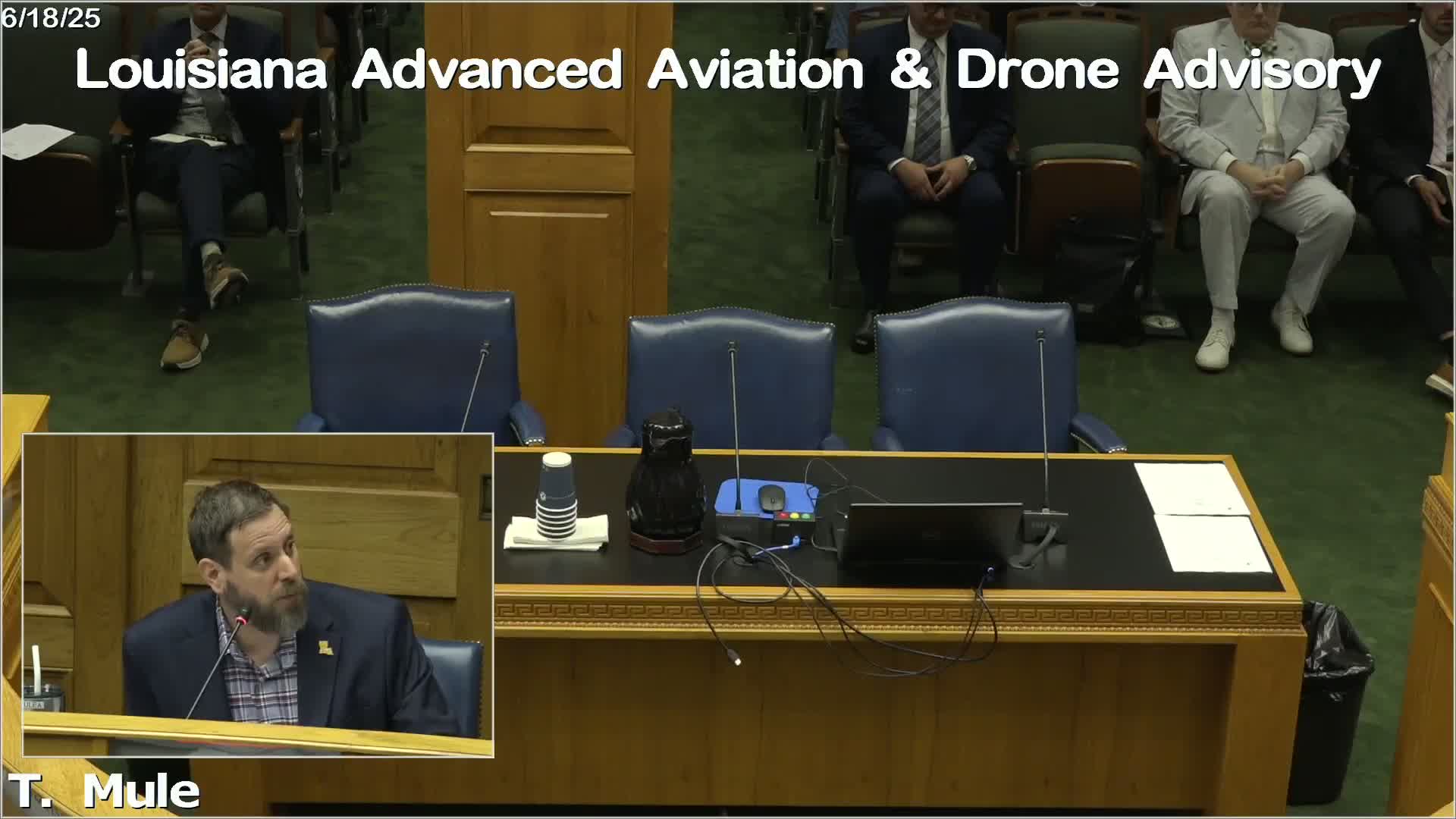
Committee member Thomas Mule, who briefed the panel on legislative developments, said stakeholders worked with Representative Gallay and others to pass House Bill 261, now Act 170, and he noted Senator Bass’s Senate Bill 9 has become Act 23; Mule said the latter “amends the definition of critical infrastructure to include military facilities.” Mule said Act 170 “makes Louisiana the first state in the country to allow for mitigation by state and local law enforcement.”
Officials stressed limits and practicalities. Gregg said the mitigation tools used by federal partners are expensive and require careful planning: “You could knock out other things, depending on what they’re at. So, it’s a huge responsibility.” He also said arrests during the operations were zero and most contacts resulted in civil or administrative follow‑up: “When we contact the people, they’d fill out all the information, send us pictures of the various drones, and then send them on their way because that’s about all we could do at the time.”
Public‑facing outreach was also a key lesson. Officials printed flyers, distributed signs along parade routes and used social media, concluding that many pilots who violated temporary flight restrictions were “ignorant and ill informed” rather than malicious. Gregg and Franklin urged early planning, cross‑agency communications, redundant detection systems and public education for future large events.
The committee discussed next steps and policy implications. Members and presenters agreed the new state laws will add capabilities but will also require agencies to refine rules of engagement, acquire and train on mitigation equipment, and coordinate with federal partners on tactics and forensics. The committee did not take a formal vote on operational policy at this meeting; presenters said federal partners still performed many of the electronic mitigations during the events and that state agencies were building organic capabilities.
Ending: Committee members thanked presenters for the operational briefing and discussed follow‑up items: better data sharing with port and airport stakeholders, clearer public outreach strategies for large events, and continuing multi‑agency training to integrate detection, ground intercept and forensic exploitation.