Get Full Government Meeting Transcripts, Videos, & Alerts Forever!
Get email alerts on the Municipal Budget topic
No spam. Unsubscribe anytime.
City staff warns flat income-tax revenue will force deeper 2026 cuts
Summary
City staff told the Springfield City Commission that income-tax revenue has flattened after post-pandemic gains, prompting more than $3 million in 2025 cuts and further reductions in the preliminary 2026 tax budget to avoid a projected $4.7 million deficit.
A city staff member told the Springfield City Commission that income-tax revenue—the backbone of the general fund—has flattened after several years of post-pandemic growth, forcing the administration to reduce the 2026 tax budget and plan additional expenditure cuts.
The presentation, delivered as the commission opened the formal tax-budget process, said income-tax growth from 2023 through 2025 added roughly $3,000,000 in total, compared with a $9,200,000 increase from 2021–22. The staff member said the city relied on about $5,000,000 in American Rescue Plan Act funds to balance the 2025 budget and that those one-time federal dollars are now exhausted.
The tax-budget document is the city’s early revenue estimate required by the Ohio Revised Code to be filed by July 15. The staff member said the tax budget both requests any needed millage for real-estate collections and sets the revenue base that caps the next year’s appropriation ordinance. “Income tax revenue, which is the backbone of our general fund, has flattened,” the staff member said.
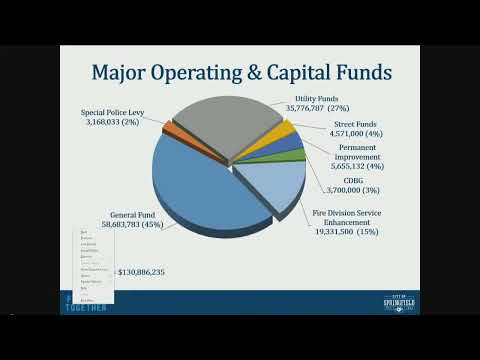
Key figures presented included: income tax now represents roughly 81% of general fund revenue; each 1 percent change in income-tax collections equals about $500,000; a conventional roll‑forward of the 2025 expenditure baseline would create a roughly $4,700,000 deficit for 2026; and the city has already implemented more than $3,000,000 in spending reductions for 2025.
To close part of the gap, staff said the 2026 tax budget reduces planned general-fund expenditures from about $63,400,000 to $58,900,000. Staff also noted changes to where some expenses are recorded: the fire division budget was moved in 2024 into a separate fire division service-enhancement fund, and that fund receives a subsidy from the general fund.
Staff said the city is transitioning its income-tax collection to the Regional Income Tax Agency (RITA), which the presenter described as an effort to strengthen compliance and collections; the accounting change means December collections will be recorded in January, producing an 11‑month appearance in 2025 income-tax receipts under cash-basis accounting. Staff projected a cautious 2.5% increase in income-tax revenue for 2026 under that full 12‑month view.
Commissioner Dr. Estrop praised staff for bringing the problem to the commission early and framed the options as increasing revenue, decreasing spending, or a combination of both. “We’ve got to increase revenue or we gotta decrease expenditures or we gotta do a little of both,” Dr. Estrop said. He also thanked voters for approving the 0.4% income-tax levy, saying that levy had helped avoid earlier insolvency.
Staff outlined the budget timeline: the commission must adopt the tax budget by July 15; department expenditure requests will be reviewed over the summer; the city manager’s preliminary budget must be filed by Nov. 1 under the city charter; and the commission will hold public budget hearings in November and an appropriation ordinance in mid-December.
At the close of the hearing, a motion to conclude was moved, seconded and approved on a roll call vote: Mrs. Brown — yes; Commissioner Dr. Estrop — yes; Mrs. Halston — yes; Mrs. Tackett — yes; Mr. Rue — yes.
The staff presentation emphasized that without sustained income-tax growth or new revenue streams, the city will continue to prioritize core services and make further spending reductions as the administration prepares the full 2026 expenditure budget in the fall.