Lifetime Citizen Portal Access — AI Briefings, Alerts & Unlimited Follows
County prosecutors, law enforcement and advocates outline domestic violence response at Springfield work session
Loading...
Summary
Clark County prosecutors, the sheriff's intimate partner crimes unit and victim advocates briefed the Springfield City Commission on barriers victims face, efforts to pursue cases with or without victim cooperation, training initiatives and gaps in staffing and funding.
At a Springfield City Commission work session, Clark County and city prosecutors, the Clark County Sheriff's Office and community advocates described how the local criminal justice system handles domestic violence, stalking, strangulation and protection-order violations and the barriers that keep victims from participating in prosecutions.
The presenters told commissioners that domestic violence cases often involve ongoing relationships, complex safety and economic considerations and a pattern of repeated contact that makes expecting immediate cooperation from victims unrealistic. Speakers said agencies are coordinating more closely across law enforcement, prosecution and community-based advocates but continued staffing and funding shortfalls limit capacity.
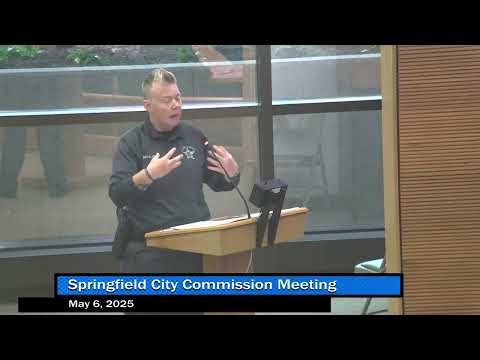
Sergeant Denise Jones of the Clark County Sheriff's Office, who leads the office's intimate-partner crimes unit, said officers must treat domestic-violence victims differently than other crime victims because offenders often share households, finances and children with victims. "Domestic violence spans the entire socioeconomic scale in a community," Jones said. "It's not just relative to people that are homeless. It's not just relative to communities of color." She added that victims frequently attempt to leave repeatedly — "7 to 9 times" was cited in the presentation — and that immediate arrest does not remove many of the practical risks victims face, such as lost income, housing and health care access.
Erin McNinty, chief prosecutor for the City of Springfield, described how municipal misdemeanor cases are filed and handled in Clark County municipal court and how the prosecutor's office seeks to make participation easier. McNinty said her office sends victims a single point of contact and a rights sheet that cites Marsy's Law, Ohio's constitutional victims' rights amendment, and will allow victims to appear by phone for hearings when possible. She also said Springfield Police body-worn camera footage is increasingly useful evidence when victims are unavailable to testify.
Assistant Clark County prosecutor Rebecca Sedan said many cases that begin in municipal court later become felony filings in the common pleas system, which can appear as "dismissed, prosecutor request" in municipal records even though the matter proceeded at a higher charging level. "If you look only at the records of municipal court, one could conclude that you're dismissing a lot of cases," Sedan said; she added that in many instances the dismissal reflects transfer to felony court rather than a resolution in favor of the defendant.
Speakers described operational steps intended to reduce barriers to victim participation and to pursue cases without victim testimony when other evidence exists. Those steps include embedding community-based advocates (who can offer privileged, confidential conversations) with law enforcement response, lethality assessment protocols for deputies, using recorded jail calls and 911 recordings, using body-camera and other video evidence, and assessing the possibility of prosecuting without the victim when corroborating evidence is available.
Lauren Dennis, a supervisor advocate with the Clark County victim-witness division who previously worked with Project Woman, explained the difference between community-based advocates and court- or system-based advocates: community advocates provide confidential safety planning and resource connections, while court advocates guide victims through prosecutorial and courtroom processes. Dennis said the county currently employs three system-based advocates in the victim-witness division; Project Woman and other community partners also provide advocates.
Officials acknowledged limited resources. Jones said the sheriff's office handles roughly 650 to 750 calls a year related to intimate-partner violence countywide and that the county unit was expanded after a 2017 grant from the International Association of Chiefs of Police. The panel also said federal grant opportunities have tightened, leaving some planned expansions on hold.
Panel members described ongoing countywide cooperation: prosecutors, law enforcement and advocacy groups now meet regularly to coordinate on repeat and high-risk offenders, identify training gaps (including on hearsay exceptions), and offer cross-agency training open to local law enforcement. Sedan said the current approach is intended to pursue accountability even when victims cannot or do not want to participate, while still centering victims' safety and choices.
Commissioners asked about data, benchmarks and program effectiveness. Panelists said some data is tracked for grant reporting (for example, Victims of Crime Act/VOCA-funded services recorded by victim-witness), and some agencies maintain local spreadsheets on calls, repeat offenders and service use, but there is not yet a unified, public-facing civilian statistic that captures the full scope of domestic-violence-related filings across municipal and common pleas courts because cases can be charged under many different statutes (aggravated burglary, robbery, stalking, strangulation) and because filings shift between courts.
At the end of the session, a commissioner asked the panel to forward information about federal and state funding the agencies have lost or grants they have declined; commissioners asked that materials be submitted to the commission's point of contact for compilation. The meeting ended with a motion to adjourn that passed on roll call.
Votes at a glance: Motion to adjourn — passed; roll call: Brown, Dr. Estrop, Houston, Tackett and Root voted yes.