Get Full Government Meeting Transcripts, Videos, & Alerts Forever!
Get email alerts on the School Budget topic
No spam. Unsubscribe anytime.
Granite School District adopts 2025–26 budget, sets preliminary tax rate at 0.006164
Summary
The Granite School District board adopted a balanced 2025–26 budget, approved a preliminary tax rate of 0.006164 and scheduled a truth-in-taxation hearing for Aug. 5 after discussion of lost state funding, new mandates and capital projects.
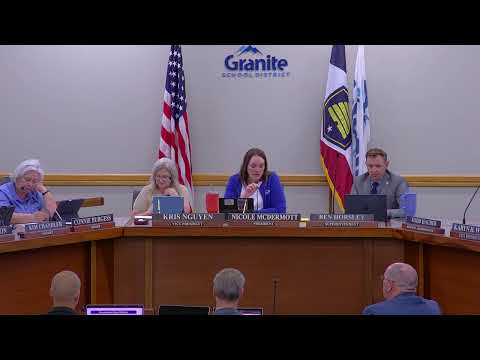
The Granite School District Board of Education on Tuesday adopted a balanced 2025–26 budget proposal, set a preliminary tax rate of 0.006164 and scheduled a truth-in-taxation hearing for Aug. 5, the board president said at the close of a June 17 public budget hearing.
The budget hearing and vote followed a presentation by district staff that outlined a general fund plan of roughly $725 million, a capital outlay program of about $105 million, and priorities including reduced class sizes in kindergarten through grade 2, instructional coaches, additional administrative support at each school and school safety staffing to meet recent legislative requirements.
Todd Hubbard, a district budget presenter, told the board the proposed budget balances planned spending against multiple new and changed funding pressures, including the state’s move away from the professional staff program (resulting in a roughly $2.2 million loss), new parental/postpartum leave requirements and increased charter-school levy obligations. "We lose $2,200,000 as the bottom line there with the change that they've made to that funding formula," Hubbard said during the presentation. He also noted an estimated $13.7 million in additional revenue from an increase in Weighted Pupil Unit (WPU) value and other one-time state funds.
Why it matters: the board must adopt a budget by state deadlines while the public still has a chance to influence final property-tax decisions at the truth-in-taxation hearing. The package adopted Tuesday includes recurring personnel costs that take effect July 1 — including step and lane increases plus a 1.75% cost-of-living adjustment — while some revenue items remain uncertain until the state certifies final levies.
Key items and fiscal drivers - General fund and operating priorities: The presentation shows most salaries and benefits are in the general fund; district priorities include reducing K–2 class sizes, software for English learners, college access supports, and 38 full-time-equivalent positions for instructional coaching and teacher prep time support. - Administrative support: The budget creates a new "Dean of Students" position and funds at least 0.5 FTE of administrative support for every elementary school to supplement principals. "This will be the first year in Granite School District history that every school will have additional administrative support," a staff presenter said. - School safety and mandates: Hubbard said recent bills require school guardians in every school and other safety measures, which the budget includes as substantial recurring costs. - Capital program: The capital outlay fund supports ongoing construction and renovations, with projects on the near-term docket including Cypress and Skyline high schools, and future projects funded by a pay-as-you-go model. Hubbard said about $58.6 million is planned for pay-as-you-go capital in fiscal year 2026, with portions to finish current projects and the balance for future projects. - Revenue pressures and offsets: The district cited new growth in property tax revenue, approximately $13.7 million in WPU value increases, savings from lower-than-expected risk-management premiums, a partial preschool grant of $500,000 (the district had requested $1.5 million), and roughly $1.3 million in savings tied to the planned closures of Orchard and Redwood elementary schools. However, an increased charter-school levy obligation — about $1.4 million higher than the prior year, rising from roughly $6.0 million to $7.4 million — creates an immediate shortfall the budget must absorb.
Public comment and board reaction Two members of the public spoke during the hearing. Amy Warren, a resident, thanked the board for "making those hard decisions" and urged approval. Michelle Jones, identified as GEA president, told the board the legislature had placed districts "in a sticky position" and urged the board to pass the budget.
Board members asked clarifying questions about the timing of tax-rate adoption and budget mechanics. Board members and staff explained that Utah timelines require a preliminary adoption now, with a truth-in-taxation hearing after tax notices are mailed; the board may adjust tax rates following that public hearing, but personnel actions and some commitments take effect July 1. As board member Julie Jackson summarized the practical tension: approving operating commitments before taxpayers see final tax notices places the board in a difficult timeline.
Votes at a glance - Approve final revised 2024–25 budget as published — Motion carried (yes: 8, no: 0). The board approved the revised prior-year budget at the hearing. - Adopt proposed 2025–26 budget as published — Motion carried (yes: 7, no: 1). Board member Kim Chandler recorded a dissenting vote citing concerns about some expenditures and the proposed tax increase. - Set preliminary tax rate at 0.006164 (subject to changes in the state basic levy) — Motion carried (yes: 7, no: 1). - Schedule a truth-in-taxation hearing for Aug. 5, 2025, at 7:30 p.m. — Motion carried (yes: 8, no: 0).
What’s next The board adopted the proposed budget and a preliminary tax rate; the district must publish tax notices and hold the truth-in-taxation hearing scheduled for Aug. 5, 2025, at 7:30 p.m. Final certified rates from the state and county may change the district’s tax calculations and the board retains authority to adjust levies following that hearing.
The hearing included staff estimates and figures; several items remain contingent on final state certifications or future grant awards, and staff noted that one-time funds were being used in some areas (for example, preschool funding and certain pilot programs) while other commitments are being funded on an ongoing basis.