Get Full Government Meeting Transcripts, Videos, & Alerts Forever!
Get email alerts on the Comprehensive Plan Update topic
No spam. Unsubscribe anytime.
College Place staff say city needs roughly 1,500 housing units by 2046; multifamily shortfall drives proposed UGA changes
Summary
College Place staff told commissioners on a regular-agenda item that the city needs about 1,504 new housing units inside city limits by 2046 and that the principal shortfall is in multifamily housing.
College Place staff told commissioners on a regular-agenda item that the city needs about 1,504 new housing units inside city limits by 2046 and that the principal shortfall is in multifamily housing.
The land-capacity analysis, prepared with consultant JV Engineers and presented during the meeting, used Office of Financial Management (OFM) population projections adopted by the county and Commerce’s Housing Allocation Planning (HAP) tool to convert population projections into housing-unit needs. Staff reported that the countywide population projection used for the analysis is 23,112 and that College Place’s population was shown in the packet as about 8,700 in 2010 and 9,900 in 2020, with an increase of roughly 3,439 people projected by 2046 (to about 13,041 in the materials).
Why it matters: the HAP tool output drives how much land and what zoning changes the city must request in UGA reallocation applications. Staff said the city must demonstrate supply or planned supply for the full range of housing affordability levels the HAP tool requires.
Key findings from staff’s presentation
- Housing need: The HAP-tool-derived need for College Place was reported as 1,504 housing units by 2046. That need is split by affordability/type in the HAP assumptions: 208 units at the 120%+ AMI single-family level and roughly 1,300 multifamily units at lower density/affordability tiers; the packet said no additional manufactured-home park capacity is required.
- Existing capacity vs. need: Staff reported future single-family capacity of 773 units (an excess versus the 208-unit single-family target), producing an apparent surplus of about 565 single-family units. For multifamily the city’s future capacity was reported as 914 units, leaving a multifamily deficit of about 382 units.
- Land area: The multifamily deficit was translated into needing roughly 28–29 acres of land for multifamily housing (presentation cited figures of 28.26 acres and 28.6 acres in different slides). For commercial and industrial land, staff used a 1:1 household-to-job assumption from the county methodology. With a housing need of about 1,504 units, staff said the city would need capacity for roughly 1,500 jobs; current commercial/industrial capacity was reported at 1,131 employees, a shortfall of about 370 employees that staff converted to a need for about 58 acres (39 acres commercial, 19 acres industrial).
Planned UGA applications and land-swap proposal
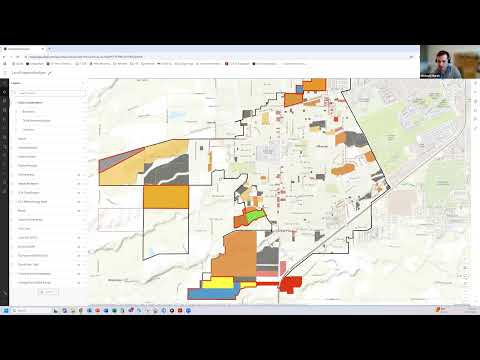
Staff described two separate submittals: (1) a land-swap application to remove certain parcels from the UGA and add other parcels of roughly equivalent single-family acreage, and (2) a separate application to request new UGA additions for multifamily, commercial and industrial needs.
- Swap details: Staff identified roughly 38.72 acres available to swap: about 24 acres at the Hay Shaker Farms parcel (now in a land trust and subject to deannexation) and about 14.5 acres in a cluster between Wallula Avenue and Northeast Rose Street (roughly 15 one‑acre lots with structures where further redevelopment is unlikely). The swap would be a like-for-like single-family to single-family exchange and cannot exceed the acreage being removed.
- UGA additions and up‑zoning: To address the multifamily shortfall, staff identified candidate UGA additions and possible in‑city rezones, including a Lipiani parcel next to Lions Park (candidate for up‑zoning near a bus route), a block off Larch under consideration for rezoning from single‑family to multifamily, and a 20.7‑acre parcel north of Wallula that staff proposes for multifamily and possible public‑use (park) designation. Staff said some privately owned parcels (for example a large family parcel owned by Doug Saturno) are unlikely to develop as multifamily within 20 years and were left as single‑family.
- Commercial/industrial: Staff pointed to the Boogie property near Martin Airfield (about 20 usable acres after right-of-way) as a candidate industrial UGA addition with capacity for roughly 123 industrial employees, and Harbini/Hodgins-area parcels near the highway and school site as commercial candidates (approximately 23.5 acres). Staff noted uncertainty about job capacity tied to the proposed school property because any school reconfiguration would change employment estimates.
Discussion highlights and constraints
Commissioners and staff discussed several trade-offs: why propose single‑family swaps when multifamily is the area of greatest need; the practical realities that some multifamily-designated parcels have not developed and that developers continue to show interest in single‑family construction; and the limits on swapping acreage (a swap cannot create a larger acreage addition than the acreage removed). Staff said there is no present funding penalty for selecting different categories in the application and that flexibility to alter applications exists as the process proceeds.
On deannexation and land trust parcels, staff explained that state law provides a process for deannexation but is uncommon and has strict criteria (peripheral location, not served by city utilities, etc.). The Hay Shaker Farm parcel is in a land trust and staff said the owners have signaled they will not develop; the parcel therefore may be removed from the UGA as part of the swap process but will remain in the UGA until the county approves removal.
Votes at a glance
- Approve agenda: motion passed (moved and seconded during the meeting; body approved). The consent/agenda procedure was discussed and clarified on the record. - Approve April meeting minutes: motion passed (moved by Commissioner Ricewig; second recorded). - Excuse absences of Commissioners Ivy and Santillano: motion passed (moved by Commissioner Rice; second recorded). - Adjournment: motion to conclude the meeting was moved and seconded and passed.
Next steps and outlook
Staff said the city’s consultant is continuing to refine acreage and rezoning calculations and that the two applications (swap and remainder additions) will be submitted separately. Staff also said the applications can be adjusted as the county review and public process proceed. No formal land‑use amendments, rezones or UGA additions were adopted at the meeting; the session was an informational presentation and direction to prepare the applications.
Ending note: The land-capacity tables, methodology and maps referenced in the presentation were included in the meeting packet and are cited by staff as the basis for the acreage and unit calculations.